

















How investments are changing the future of esports organizations
Esports has definitively ceased to be just a competition for enthusiasts, transforming into a serious economic ecosystem. Today, financial injections determine not only the size of prize pools but also the very structure of club management. I believe we are at a stage where capital dictates the rules of the game, turning teams into high-tech media assets. Professional gaming now requires sustainable business models capable of withstanding market fluctuations. It is an evolution that makes the industry more mature, but also much more pragmatic.
Professionalization of Management and Infrastructure
Modern investments are primarily directed toward creating infrastructure that was previously available only to top-tier football clubs. I see organizations building their own training facilities and hiring staffs of nutritionists, psychologists, and data analysts. This transforms yesterday’s gaming houses into high-tech training centers where every aspect of a player’s life – from sleep patterns to diet – is under the strict supervision of specialists. Such a systematic approach minimizes burnout risks and allows esports athletes to maintain peak form throughout the entire season.
This directly impacts results and the balance of power on the global stage. If you study the best cs2 teams to watch in 2026 and track their progress, it becomes clear that the ranking leaders are most often those who have invested millions into their academies and player conditions. Clubs have stopped looking for ready-made stars, preferring to grow them in their own incubators where young talents are taught discipline and a professional attitude from an early age. In my view, it is precisely the presence of a deep “bench” and a well-oiled talent development system that separates Tier-1 organizations from everyone else today.
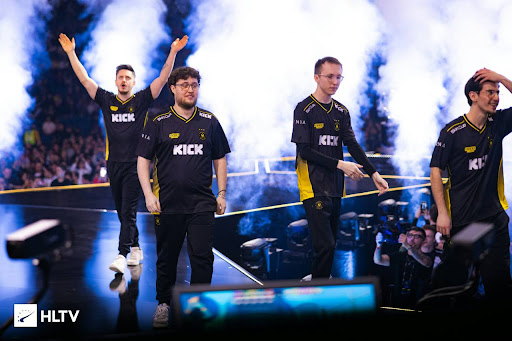
Projects such as Team Vitality’s modern bootcamps or Team Falcons’ massive investment programs clearly demonstrate that a systematic approach to training yields much more stable results than simply betting on individual talent. When a player has a powerful analytical staff behind them, capable of dissecting an opponent’s actions down to the smallest detail, the cost of a personal mistake decreases. Ultimately, victory goes not to the one who presses buttons better, but to the one whose organization has created a more effective environment for realizing that potential.
Diversification and Media Assets
Investors no longer want to depend exclusively on tournament victories, as it is far too risky and unpredictable. I believe the modern esports business has definitively reevaluated its priorities: organizations are starting to invest heavily in creating original content and developing players’ personal brands, turning them into full-fledged influencers. This allows them to maintain sponsor loyalty even when a team fails to make the playoffs, as reach and audience engagement remain consistently high.
Clubs like G2 Esports or 100 Thieves have effectively become media houses, where streaming, vlogging, and selling exclusive merch generate far more revenue than prize pools. In my view, this is the only viable path to financial independence, allowing an organization to stay afloat even during prolonged competitive slumps. Now, a player’s contract is not just a commitment to win, but a readiness to be the face of a brand, participate in shows, and interact with fans 24/7.
This approach changes the very essence of supporting a team: the viewer becomes attached to personalities and their stories, rather than just the score on the board. I see that a team’s success today is measured not only by the number of trophies but also by million-strong social media reaches, which convert into long-term contracts with brands of the caliber of Red Bull or BMW. Ultimately, a victory in the final becomes just a pleasant bonus to an already established and profitable media machine.
Influence of State Capital and Funds
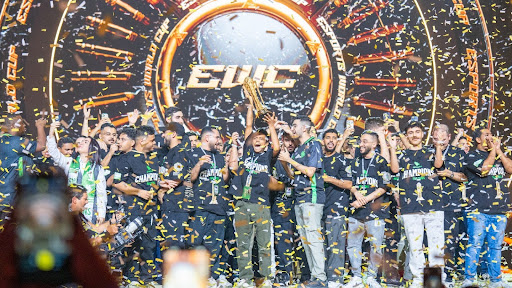
In recent years, we have witnessed the arrival of massive state capital, particularly from Middle Eastern countries, which is fundamentally changing the rules of the game. Funds like Saudi Arabia’s Savvy Games Group are pouring billions of dollars into the industry, inevitably leading to market consolidation and the creation of planetary-scale mega-tournaments such as the Esports World Cup. I believe this transforms the landscape of the entire sector, making it more centralized and dependent on the decisions of a few key players.
This financial injection provides a powerful boost for the development and preservation of legacy disciplines like Dota 2 or League of Legends, ensuring their stability for years to come. However, there is a flip side to this coin: colossal budgets sharply raise the barrier to entry for new, less affluent organizations. In my view, it is becoming practically impossible for young clubs without serious external support to compete for top-tier players whose salaries have skyrocketed under the influence of state investments.
Ultimately, the industry is gradually turning into a battlefield not only for player skill but also for the influence of massive financial corporations and entire nations. We are seeing esports become a tool of soft power and a part of the global development strategies for entire regions. I believe this trend will only intensify in the near future, and we will have to get used to the fact that the fate of major trophies is decided not only on the server but also during large-scale interstate investment deals.
Tech Stack and Analytics
Investments in modern tech allow clubs to use AI for deep match analysis and global talent scouting. Organizations now use specialized software to track everything from in-game metrics to an athlete’s heart rate and concentration levels in real-time. This creates a “digital laboratory” where every action is dissected, revealing patterns invisible to the human eye.
In fast-paced games like Valorant or Rainbow Six Siege, where a second’s delay is fatal, processing this data into tactical decisions is a massive strategic advantage. Analytical staffs are evolving into full IT departments, developing proprietary software to gain a competitive edge.
Ultimately, technological dominance is becoming as vital as reaction speed. We are entering an era where Major outcomes will depend on the “digital brain” of a team—algorithms capable of predicting an opponent’s moves before the round even begins.
Conclusion
To sum up, money is making esports more stable and professional, but at the same time, it is erasing its former romance. We are entering an era where long-term planning and financial discipline become more important than short-term success at a single Major. I believe only those organizations that can find a balance between sporting ambitions and commercial efficiency will survive. Esports is now not just a game, but a battle of strategies in investors’ boardrooms.