
















Minds and Might: The Martial Arts of the U.S. Military
In the modern era of technologically advanced warfare, the raw, primal reality of hand-to-hand combat remains a vital component of military readiness. Across the branches of the United States Armed Forces, specialized martial arts programs are not merely about fighting; they are about forging warriors with the physical, mental, and moral fortitude to dominate in close-quarters engagements.
From the highly structured and philosophical Marine Corps Martial Arts Program (MCMAP) to the battlefield-focused Army Combatives, each service branch has cultivated a unique approach to unarmed and armed combat training.
Marine Corps: “One Mind, Any Weapon”
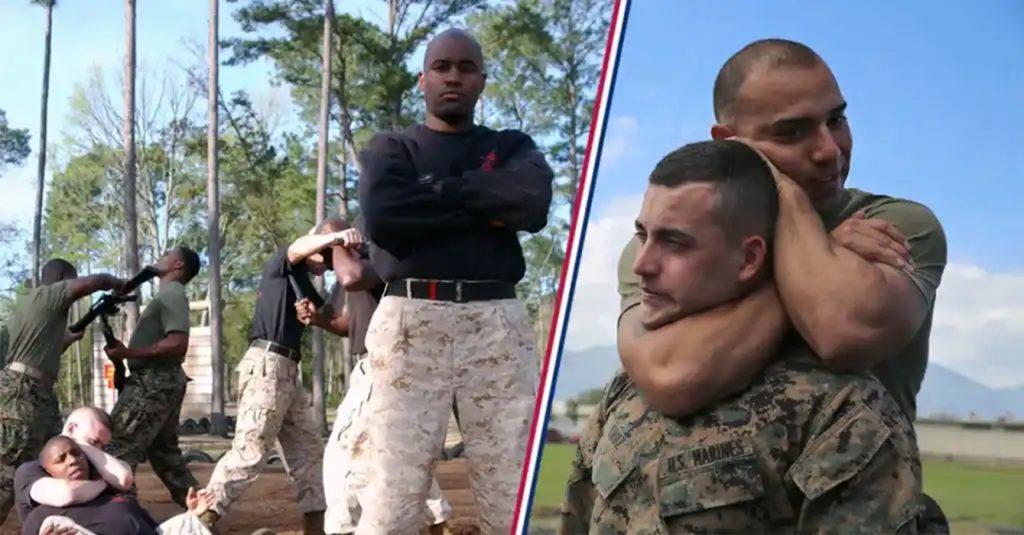
The Marine Corps Martial Arts Program, or MCMAP, is arguably the most iconic and comprehensive martial arts system in the U.S. military.
Established in 2001, MCMAP is a hybrid system that blends techniques from 17 different martial arts, including Brazilian Jiu-Jitsu, wrestling, judo, and Muay Thai. Its motto, “One mind, any weapon,” underscores the program’s holistic approach, which extends beyond physical techniques to encompass mental and character development.
MCMAP training is woven into the fabric of a Marine’s career, with a belt-ranking system similar to traditional martial arts, progressing from tan to black belt with multiple degrees.
The program is divided into three disciplines: physical, mental, and character. The physical discipline hones techniques for unarmed combat, edged weapons, and weapons of opportunity.
The mental discipline focuses on developing a combat mindset and studying warrior ethics, while the character discipline reinforces the Marine Corps’ core values of honor, courage, and commitment.
This comprehensive approach aims to create “ethical warriors” who can responsibly apply force across the full spectrum of violence.
Army: The Modern Army Combatives Program
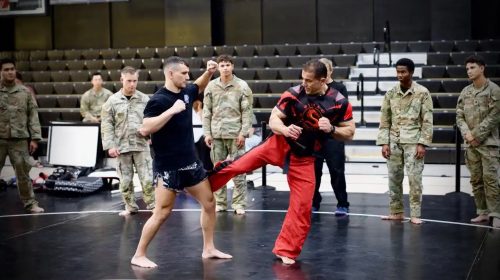
The U.S. Army’s Modern Army Combatives Program (MACP) is a battlefield-oriented system designed to equip soldiers with the skills to prevail in close-quarters combat.
Officially established in 2002, MACP evolved from earlier hand-to-hand combat training, with a significant revamp in the late 1990s and early 2000s to address the realities of modern warfare.
The program’s core philosophy is that all soldiers, regardless of their specialization, can find themselves in a hand-to-hand fight.
MACP training is structured in progressive levels, starting with a basic course for all soldiers during initial entry training.
The program emphasizes grappling techniques, drawing heavily from Brazilian Jiu-Jitsu, with the rationale that most fights will end up on the ground.
As soldiers advance through the levels, they learn to integrate striking techniques and weapon retention skills.
A key aspect of MACP is its use of competitive sparring to instill confidence and allow soldiers to apply their skills in a realistic, albeit controlled, environment.
Navy: A Spectrum of Skills
The U.S. Navy’s approach to martial arts is more varied, depending on the specific role and unit of a sailor. Navy personnel attached to Marine Corps units are trained in the Marine Corps Martial Arts Program (MCMAP).
The elite Navy SEALs, known for their specialized skills, incorporate a range of martial arts into their training, including Krav Maga, the brutally effective Israeli self-defense system; Brazilian Jiu-Jitsu for its ground-fighting dominance; and Muay Thai for its powerful striking techniques. Traditional boxing skills, emphasizing footwork and agility, also form a core component of their close-quarters combat training.
For the wider Royal Navy, training is offered in more traditional martial arts such as Karate, Kendo, and Tae Kwon Do.
Air Force: Grounded in Combatives
Recognizing the need for airmen to be prepared for ground combat scenarios, the U.S. Air Force adopted the U.S. Army Combatives Program as the foundation for its own training in 2008.
The U.S. Air Force Academy serves as the Air Force Combatives Center of Excellence, offering a Master Instructor Course to develop a cadre of skilled instructors.
The Royal Air Force (RAF) also has a robust martial arts community, with the RAF Martial Arts Association supporting a wide variety of disciplines, from Brazilian Jiu-Jitsu to Kendo and Muay Thai.
While the specific techniques and programs may differ, the underlying principle of martial arts training across the U.S. military is the same: to produce resilient and effective warfighters. These programs are not just about physical prowess; they are about instilling the confidence, discipline, and warrior ethos necessary to face any threat, at any range.