












Anjouan Gaming Licence for Crypto Casinos: Requirements, Full Cost Breakdown, and How to Choose a Licensing Agent
The Anjouan gaming licence is issued by the Anjouan Offshore Financial Authority (AOFA) under the Computer Gaming Licensing Act No. 007 of 2005. It is a single B2C/B2B permit covering online casino, sports betting, poker, and live dealer verticals operated from the Autonomous Island of Anjouan in the Comoros archipelago.
For crypto operators, two concrete advantages stand out at this price point. First — explicit support for cryptocurrency transactions: Bitcoin, Ethereum, USDT. Second — 0% tax on GGR, 0% corporate tax, no VAT. The initial licensing fee is approximately €17,000, and approval takes four to six weeks. That is why Anjouan has become one of the most affordable regulated entry points in iGaming for early-stage and crypto-native projects.
What follows is the specifics: what is required to apply, what the full first-year budget looks like, where the process stalls, and what to look for when choosing an agent — with no unnecessary surprises.
Who the Anjouan licence fits and what it actually permits
The licence is issued by the Anjouan Offshore Financial Authority (AOFA) under the Computer Gaming Licensing Act No. 007 of 2005. It is a single permit covering multiple product types within one application — convenient for operators who want to combine verticals without obtaining separate licences for each.
The licence suits two types of operators:
[BLOCK: scope matrix table (B2C vs B2B, product types covered)]
Who it genuinely fits: crypto casinos at launch that need a legal entity quickly; white-label platforms entering second-tier markets; B2B software and content providers that need a licensed structure for contracts with B2C clients. Operators targeting players from the EU or UK will find it insufficient — those markets require local licences regardless of offshore status.
The AOFA licence is an operational permit. It does not open bank accounts, does not pass PSP onboarding, and does not unlock restricted markets. Operators who treat it as a key to payment infrastructure run into problems immediately. The licence is a starting point, not a ready-made solution.
Anjouan gaming licence requirements for a crypto casino
To obtain the licence, a crypto casino needs: a clean corporate structure, verified owners and directors, AML/KYC controls, a functional technical platform, and a document package confirming compliance. Most applications stall or receive a rejection because one of these categories is incomplete or incorrectly prepared.
Corporate structure and ownership documents
- Certificate of incorporation and articles of association from the registration jurisdiction
- Confirmation of registered address and nominee arrangements (if applicable)
- Ownership chart identifying all UBOs with stakes above the threshold — typically 10–25%
- Shareholder register and corporate resolutions authorising the licence application
Personal due diligence and fit-and-proper checks
- Notarised passport copies and proof of residential address for each director and UBO
- Criminal record certificates — typically apostilled and no older than three months at the date of submission
- Professional CVs covering relevant business or gaming industry experience
- Source-of-funds and source-of-wealth declarations — particularly critical for crypto-funded projects
AML, KYC, and compliance documentation for crypto operators
The bar here is higher for crypto projects. The regulator expects a written AML/KYC policy that explicitly covers digital asset operations — not a fiat-era template. Additionally required: a designated compliance officer, a responsible gambling policy, and — increasingly — references to on-chain monitoring tools or procedures for identifying suspicious wallet activity.
Technical platform and B2B provider readiness
- Signed agreements with licensed game content and platform providers.
- Description of payment flows: crypto on/off-ramp and fiat channels, if applicable.
- Domain and hosting details; confirmation that the platform applies geofencing for restricted markets.
Corporate structure and ownership documents
The core corporate package: certificate of incorporation, shareholder register, UBO declaration, and proof of registered address.
What to prepare:
- Certificate of incorporation — issued in the jurisdiction where the operating company is registered.
- Shareholder register — all direct and indirect owners with percentage stakes.
- UBO declaration — full beneficial ownership chain down to natural persons; a stake of 25% or more at any level triggers mandatory disclosure.
- Proof of registered address — a genuine local address, not a PO box.
Common issues that stall applications:
- Nominee shareholders or directors without documented disclosure — AOFA will request additional materials and source-of-funds evidence
- Multi-layer holding structures where UBO identity is distributed across jurisdictions
- Incorporation documents that are expired, unnotarised, or lack an apostille
Straightforward, direct ownership chains move faster. The more layers between the applicant and the beneficial owner, the more supporting evidence the regulator will require.
Personal due diligence and fit-and-proper checks
Each director and UBO must submit a passport, proof of address, CV, criminal record certificate, and source-of-funds documentation.
These personal checks go straight to character and financial integrity. The regulator wants to know whether each key person is genuinely fit to run a licensed gambling business — not just that the company structure looks clean on paper.
What to prepare for each director and UBO:
- Valid government-issued passport (notarised copy)
- Proof of address dated within the last 3 months (utility bill or bank statement)
- Detailed CV covering the last 5–10 years of professional history
- Criminal record certificate from every country of residence in that period
- Source-of-funds declaration with supporting bank statements or asset documentation
Personal KYC is usually the slowest part of the application. Criminal record certificates alone can take weeks to arrive from certain jurisdictions. Start collecting these documents before corporate formation, not after.
AML, KYC, and compliance documentation for crypto operators
A crypto casino must provide an AML policy, KYC procedures, a transaction monitoring system, and wallet verification protocols. This is substantially more than regulators require from fiat operators.
Where a fiat casino can submit a standard AML template, a crypto operator must demonstrate specifics: how wallet ownership is established, how addresses are screened against sanctions lists, and how on-chain activity is monitored in real time. The regulator expects documented processes, not statements of intent. What your compliance package must cover:
- AML policy — jurisdiction-specific, including risk appetite, suspicious transaction reporting procedures, and escalation protocols
- KYC / player verification — identity checks at registration, enhanced due diligence for high-volume depositors and anonymous wallets
- Transaction monitoring — tools or manual procedures for detecting atypical deposit patterns, rapid withdrawals, and layering indicators
- Wallet screening — checks against OFAC, EU, and UN sanctions lists before processing any withdrawal
- Same-coin policy — deposits and withdrawals must be processed in the same cryptocurrency; cross-coin conversion creates AML exposure and complicates PSP relationships
Blockchain analytics integration — tools such as Chainalysis or Elliptic — is not formally mandated in Anjouan’s requirements. However, operators without on-chain monitoring are routinely declined by payment processors regardless of their licence status.
Technical platform and B2B provider readiness
The regulator verifies that the platform is genuinely operational and integrated — before the licence is issued, not after. Specific documentation is required:
- Gaming provider agreements — signed B2B contracts with certified suppliers; each must confirm that the provider is licensed in a recognised jurisdiction
- RNG certification — independent test lab reports for games based on a random number generator (slots, virtual table games); providers do not always include this automatically, so verify coverage per title separately
- Platform architecture documentation — a technical description of the system: data flows, player account management, and AML/KYC controls built into the software layer
- Hosting and server location confirmation — infrastructure must be located in a non-restricted jurisdiction; documented uptime and security standards are required
- Payment integration evidence — records showing how crypto on/off-ramp and any fiat PSP connections are configured and monitored
Incomplete provider agreements and missing RNG reports are the most frequent causes of delays at the technical review stage. Prepare these materials in parallel with corporate documents, not after them.
Full Anjouan gaming licence cost breakdown: fees, setup expenses, and first-year budget
The realistic first-year budget is the sum of official licensing fees, platform costs, company formation expenses, legal and compliance support, and renewal costs. The headline figure is only part of the picture.
Founders typically focus on the regulatory fee and underestimate everything else. The table below separates fixed official payments from variable service-provider costs — to build a realistic budget before signing with anyone.
| Cost item | Type | Typical range |
|---|---|---|
| Initial licence fee (AOFA/ALSI) | Official | ~€17,000 |
| Annual licensing platform fee | Official | €828/year |
| Company formation (offshore entity) | Official + service | €1,100–€4,000 |
| Compliance officer / key person authorisation | Official | €2,000 per individual |
| Legal review and document preparation | Service-provider | varies by agent package |
| AML/KYC policy drafting and technical compliance setup | Service-provider | varies; can be bundled |
| First-year total (estimated) | Combined | €18,000–€30,000 |
What varies and why it matters:
- Fixed official costs are set by the regulator: the licence fee, platform fee, and per-compliance-officer charge — these are non-negotiable.
- Variable costs depend on the agent, the complexity of the corporate structure, and how much compliance work the operator handles internally. A simple structure with a single director sits at the lower end of the range; multiple shareholders or layered ownership increases both formation and legal costs.
- Renewal is not free. Annual renewal includes the platform fee plus re-authorisation of compliance officers — budget for this from the start rather than treating initial costs as a one-off payment.
By cost, Anjouan remains the most accessible among comparable offshore jurisdictions. Underestimating service-provider expenses is the most common mistake operators make before signing an agent agreement.
How the Anjouan application process works and where delays usually happen
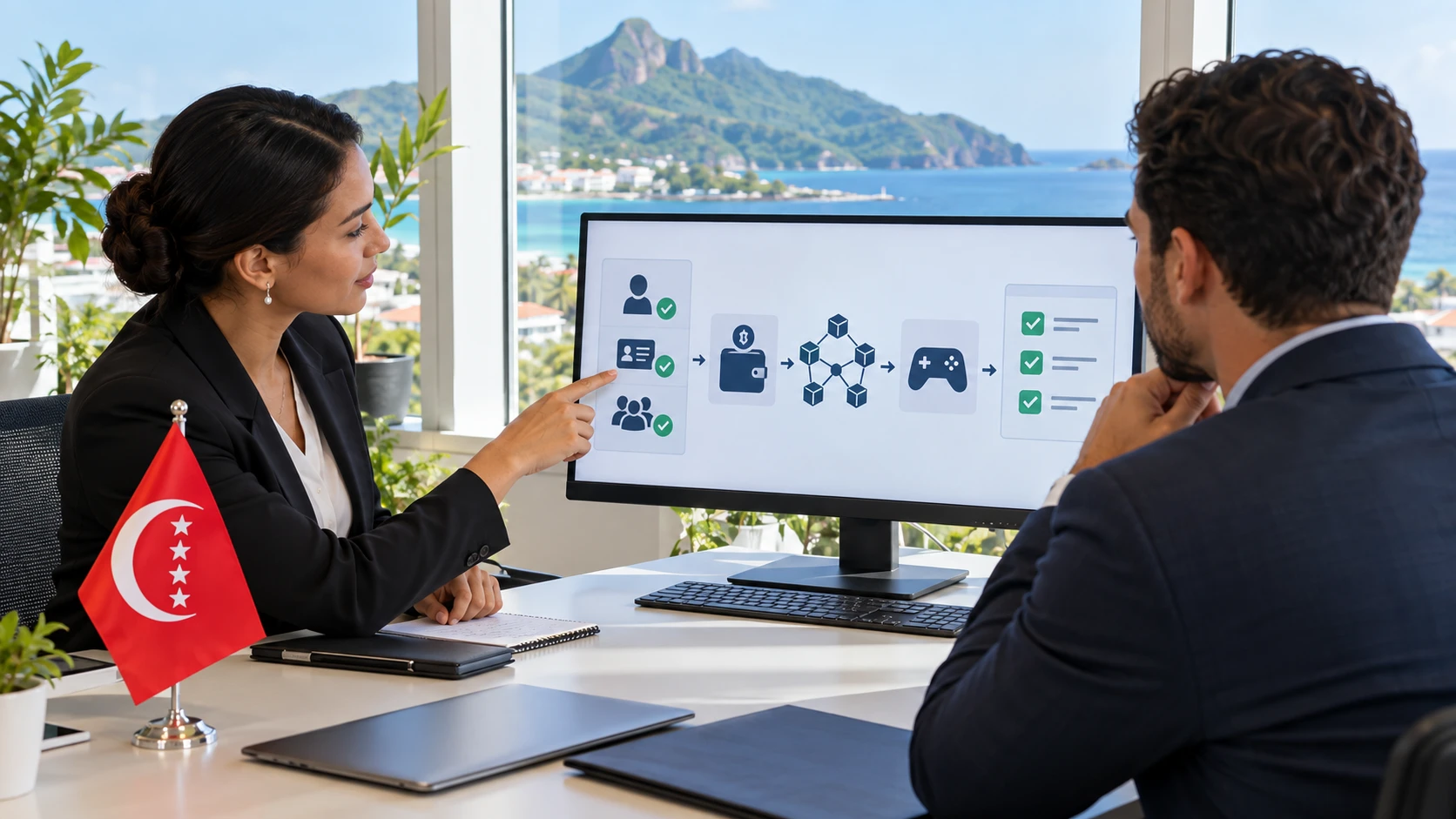
The process runs from scoping and company registration — through document preparation, application submission, due diligence, and clarification requests — to licence issuance. Delays almost always stem from weak KYC, compliance gaps, or an unclear payment architecture.
Stage 1 — Scoping and registration
First, determine whether a B2C or B2B licence is needed. Then register the company in Anjouan. A common early mistake is a mismatch between UBO data in the corporate registry and the application — this stalls the process immediately.
Stage 2 — Document preparation
Required: corporate certificates, ownership records, director identification, source-of-funds confirmation, a full AML/KYC policy, and technical platform documentation. Crypto operators must also describe the on-ramp/off-ramp structure. A vague payment diagram is a direct path to regulator correspondence.
Stage 3 — Submission and checks
The regulator reviews the beneficial ownership structure and conducts fit-and-proper checks on key persons. Directors with complex international histories noticeably extend this stage.
Stage 4 — Clarification requests
At least one round of follow-up questions is standard — particularly if the AML framework does not address crypto-specific risks or platform provider certifications are incomplete.
Stage 5 — Payment and licence issuance
Once due diligence is complete, the licensing fee is paid and the licence is issued. A clean, complete file means issuance within 10–15 business days from final approval.
Realistic timelines: A well-prepared application moves through the full process in 4–6 weeks. Files with document gaps stretch to 3 months or longer. The process itself is not complex — the bottleneck is almost always on the operator’s side, not the regulator’s.
Restricted markets, licence verification, and enforcement
Operators holding an Anjouan licence are required to block players from a fixed list of restricted jurisdictions. Licence verification is available directly through the AOFA public registry.
The standard list of restricted markets includes:
- Australia, Austria, France, Germany, the Netherlands, Spain, the United Kingdom, the United States
- Saint Kitts and Nevis, Saint Vincent and the Grenadines
- All FATF blacklisted countries and jurisdictions under international sanctions
Geoblocking must cover player registration, payment operations, and marketing — not only site access. Gaming legislation changes regularly, so confirm the current list with a legal adviser before launch and after each licence renewal.
Licence verification is straightforward: cross-reference the operator’s licence number against the public registry of the Anjouan Offshore Financial Authority (AOFA). If the number is not found in the registry, the licence is unconfirmed — regardless of what documents the operator provides.
AOFA’s enforcement powers cover licence issuance, supervision, and suspension or revocation for non-compliance. In practice, grounds for revocation include failure to meet AML/KYC requirements, operating in restricted markets, and misrepresenting the scope of the licence. Warnings alone are not the end of the process.
How to find a licensing partner for an Anjouan crypto casino
Choose a partner based on documented experience with crypto casinos, transparent pricing, concrete commitments, and proven ability to handle documents, compliance, and regulator communication — not marketing claims.
Licensing involves several parallel workstreams: corporate formation, document collection, AML/KYC framework preparation, regulator communication, and — particularly important for crypto operators — coordination with payment providers and EMIs. Not every agent covers all of this. Gaps in scope convert directly into delays or rejection.
What to verify before signing:
- Scope of work — in writing. Clarify exactly what is included: document preparation, notarisation support, regulatory submission, follow-up correspondence, post-approval support. “Full service” without a breakdown is a warning sign.
- Crypto-specific experience. Ask whether the partner has worked with on-ramp/off-ramp structures, crypto AML policies, and PSP onboarding for licensed crypto casinos — not only fiat operators.
- Fee structure. A fixed rate is easier to budget. Watch for base prices that exclude company formation, the compliance officer fee (€2,000 per person), or renewal support.
- Realistic timelines. A partner who quotes a price and guarantees approval within days without reviewing your documents is selling, not advising. For a clean, complete application, plan for a minimum of 4–6 weeks.
- Contractual protection. A reliable partner will document deliverables, refund conditions in case of rejection, and a dispute escalation process.
Red flags: guarantees of a bank account without understanding the business model; no line-item separation between government and service fees in the quote; inability to name specific compliance documents required for crypto operators.
Companies working with Anjouan licensing for crypto casinos:
- MGL Solutions — manages Anjouan applications end-to-end, with documented experience in crypto AML frameworks and PSP coordination for iGaming operators.
- Gaming Licences — licensing consultants for Anjouan and comparable offshore jurisdictions, with packages for early-stage and crypto-native operators.
- Coltfox — corporate formation, compliance documentation, and regulator liaison for Anjouan applicants, including crypto projects.
- Licensing.ag — Anjouan licensing support combined with AML policy development, B2B provider agreement review, and post-approval renewal management.
Before signing with any of the above — or any other provider — request a line-item quote separating government fees from service fees. Confirm crypto-specific commitments in writing. Check references from operators who have completed the process, not those who have only started it.