









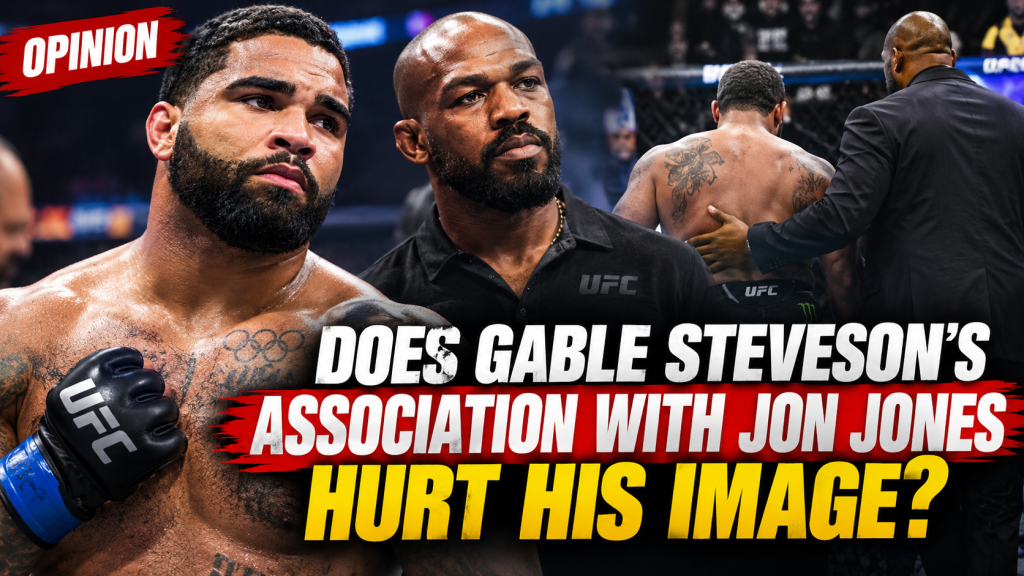
Does Gable Steveson’s Association With Jon Jones Hurt His Image?
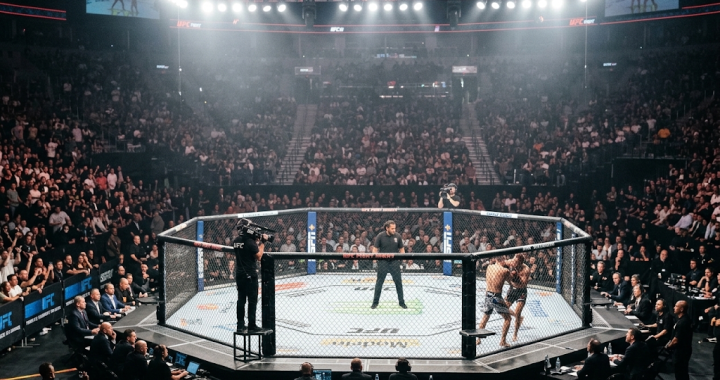
Gable Steveson entered the UFC with something very few heavyweight prospects could match: an Olympic gold medal, an extraordinary wrestling résumé and enormous expectations. But after his stunning 12-second knockout loss to Sean Sharaf at UFC 331, the conversation surrounding Steveson has shifted dramatically.
And now there is another question worth asking: Does Steveson’s close association with Jon Jones hurt his image?
The answer isn’t necessarily about Jones personally. Rather, it is about perception.
Jones has served as a mentor and coach for Steveson and was in his corner for the UFC 331 fight. After Steveson was knocked out, the Olympic champion left the Octagon before Bruce Buffer officially announced Sharaf as the winner. That immediately became a major talking point, with Daniel Cormier and Joe Rogan among those criticizing Steveson’s handling of the defeat.
At first glance, it was easy to assume Steveson simply walked away from an embarrassing loss. But Jones subsequently explained that he was the one who made the decision to take Steveson backstage, saying his immediate reaction was to make sure his friend was okay after being knocked unconscious.
That clarification changes the context considerably.
Still, the optics are difficult to ignore.
The Jon Jones Factor
Jones is one of the most accomplished fighters in UFC history, but his public image has also been shaped by years of controversy outside the cage. That means anyone closely associated with him inevitably brings some of that baggage into the conversation.
For Steveson, that association was already noticeable before UFC 331. Jones wasn’t simply another person standing in his corner. He was one of the biggest names in MMA actively helping guide the Olympic wrestling champion into the sport.
When Steveson suffered one of the most shocking defeats of the year, cameras immediately focused on Jones.
And when Steveson left the Octagon early, Jones went with him.
That created a visual narrative that was almost impossible for fans and critics to ignore.
Colby Covington has gone even further, publicly criticizing Steveson’s association with Jones and suggesting that the relationship is part of the problem. That’s Covington’s opinion, rather than an established fact, but it demonstrates how the relationship is being discussed within the MMA community.
But Is Jones Really the Problem?
That’s where things become more complicated.
Blaming Jones for Steveson’s loss would be difficult to justify based solely on what happened inside the Octagon. Sharaf landed a devastating punch just 12 seconds into the fight, ending the contest before Steveson had an opportunity to demonstrate much of the wrestling ability that made him such a highly touted prospect.
Likewise, Jones has now accepted responsibility for Steveson’s early departure from the cage.
That doesn’t make the moment disappear, but it does mean the popular interpretation that Steveson simply refused to acknowledge his opponent’s victory is incomplete.
There is also an important piece of evidence that came from Sharaf himself.
Despite all the criticism surrounding the incident, Sharaf said he encountered Steveson backstage and shook his hand. He also shook hands with Jones.
That suggests the story may have been considerably less hostile behind the scenes than it appeared on television.
The Bigger Problem Is the Hype
If anything, Steveson’s image problem may have less to do with Jon Jones and more to do with the enormous expectations surrounding him.
Steveson wasn’t introduced to UFC fans as an ordinary prospect. He was an Olympic champion with an elite wrestling background who had quickly built an unbeaten record in combat sports. By the time he reached UFC 331, expectations had become enormous.
Then Sharaf knocked him unconscious in 12 seconds.
That’s the kind of defeat that can completely change public perception.
Before the fight, fans were debating how quickly Steveson could climb the heavyweight rankings. Afterward, some were questioning whether he belonged in the UFC at all.
That’s an enormous swing.
And the early Octagon exit gave critics another storyline to attach to the loss.
Instead of simply being remembered as “Steveson got caught by a devastating punch,” the night became a conversation about preparation, hype, sportsmanship and the influence of the people around him.
That’s a much harder image to repair.
Steveson Still Has Time to Change the Narrative
The good news for Steveson is that his UFC career isn’t over.
He’s 26 years old, has an extraordinary wrestling background and suffered a loss that lasted only 12 seconds. There is still plenty of time to learn from what happened.
Jones clearly believes that is possible. Following UFC 331, he defended Steveson and said he believes his protégé can eventually become one of the UFC’s best heavyweights.
Whether that prediction proves accurate is impossible to know.
What Steveson can control is what happens next.
The best way to repair his image won’t be through another social-media statement or another explanation of what happened at UFC 331. It will be through his behavior and performances inside the Octagon.
Win his next fight.
Show improvement.
Respect his opponents.
And, if he loses again, show the MMA world how an Olympic champion handles adversity.
The Verdict
Does being associated with Jon Jones hurt Gable Steveson’s image?
It can, but the UFC 331 controversy shouldn’t automatically be blamed on Jones.
Jones’ reputation inevitably influences how people perceive those around him, and his prominent role in Steveson’s corner makes the connection impossible to overlook. But Jones has also taken responsibility for the early exit, while Sharaf has indicated that Steveson did eventually shake his hand backstage.
Ultimately, Steveson’s image will be determined much more by what he does from this point forward.
UFC 331 was a disaster for Steveson from a competitive standpoint.
The question now is whether it becomes the defining moment of his UFC career—or simply the night he learned his first major lesson in MMA.