
















From Knucklebones to Reels: Gambling’s Long Line
Ancient Gambling Games That Influenced Modern Casino Entertainment
Almost nothing in a modern casino is modern. The interfaces are new, the certification is new, and the mathematics is documented in ways that would have astonished anyone throwing bones in a marketplace four thousand years ago. The underlying propositions are not. Bet on an uncertain outcome, accept a fixed structure of odds, agree in advance what winning looks like: those rules were settled long before anyone thought to build a room around them.
Bones Before Dice
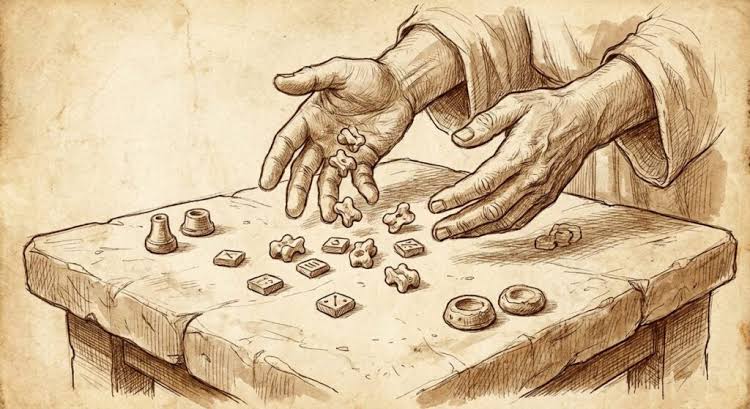
The oldest randomizers were not manufactured at all. Astragali, the ankle bones of sheep and goats, land on four distinguishable faces and were used for both divination and wagering across the ancient world.
The distinction between those two purposes was thinner than it looks now. Asking the bones what would happen and betting on the answer were often the same act, and the vocabulary of luck still carries traces of it. Purpose-made cubical dice appeared later, with examples recovered from Bronze Age sites more than four thousand years old, refining the same idea into a fairer instrument.
The Board Games That Formalized the Stake
Dice alone produce a result but not a game. What turned randomness into structured play were race boards, and two of them are unusually well documented.
The Royal Game of Ur, played roughly 4,600 years ago, survives with enough physical evidence and a later cuneiform tablet describing its rules that it can be played accurately today. Senet, its rough contemporary elsewhere, spread widely enough to be buried with the wealthy. Both combined a randomizing throw with positional decisions, which is precisely the structure backgammon still uses.
What Traveled and What Did Not
Most ancient games vanished. The ones that survived did so because their mechanics were portable, meaning they worked regardless of language, currency, or setting.
| Ancient form | Approximate origin | Modern descendant | What carried over |
| Astragali | Bronze Age, widespread | Dice games | Multi-faced random outcome |
| Cubical dice | Third millennium BCE | Craps, sic bo | Fixed probabilities per face |
| Race boards | Third millennium BCE | Backgammon | Chance plus positional choice |
| Wheel of fortune imagery | Classical antiquity | Roulette, wheel shows | Rotating pointer, fixed segments |
| Ticket draws | Imperial-era administration | Lottery, keno | Numbers drawn from a pool |
Run through a contemporary lobby with that column in hand, and the continuity becomes obvious. Seen that way, the catalog at Casino Yep reads less like a product list than a continuation: ideas polished by four thousand years of play, now running on instruments far fairer than any hand-cut die, with every outcome independently verified.
Cards Took the Longest Road
The deck is younger than the dice and traveled further to reach its current form. Paper cards emerged in imperial China around the ninth century, then moved westward through trade routes, arriving in Europe in the fourteenth century by way of the Mamluk world.
That intermediate stage left visible marks. The Mamluk deck used four suits, and their transformation into the familiar European set was a matter of local substitution rather than reinvention.
- Cups became hearts in some traditions and remain cups in others.
- Coins survive as diamonds, and as coins in decks still used for regional games.
- Swords became spades, the name descending from the sword rather than the digging tool.
- Polo sticks, unfamiliar to European players, were reinterpreted as clubs or batons.
One caution belongs here. Popular histories often attach precise origin stories to old games, including the frequently repeated claim that a lottery-style number draw financed a monumental construction project. Colorful accounts of that kind rarely survive contact with the documentary record, and the honest version is usually that a game appeared gradually, in several places, without a founder.
Four suits, ten numerals, and a small court have proved remarkably stable for six centuries, and every card game on a modern floor is a variation played on that inherited object.
The Constants Across Three Millennia
Strip away the materials, and a short list of design principles turns up in every era, which is the more interesting inheritance. A browse through the shelves of Casino Games Online shows the same handful of ideas arranged in new combinations rather than anything genuinely unprecedented.
The first constant is a transparent randomizer: a physical object everyone can watch, or in the current era, a certified generator standing in for one. The second is a fixed payout structure agreed before play, which is what separates a game from a dispute. The third is a margin held by whoever runs it, whether a temple, a state lottery, or a licensed operator.
The fourth is regulation, and it is older than most people assume. Restrictions on dice play, exemptions during festivals, and rulers who both banned gambling and practiced it enthusiastically recur across the historical record with tedious regularity.
The Oldest Format Still Running
Continuity of this kind is rare in entertainment. Theatrical forms transform beyond recognition, musical ones fragment, but a wager on a randomized outcome has held its shape since before writing was widespread.
That durability suggests the appeal was never really about the equipment. Next time a wheel spins or a card turns, it is worth remembering how few things in daily life have been done continuously for four thousand years.