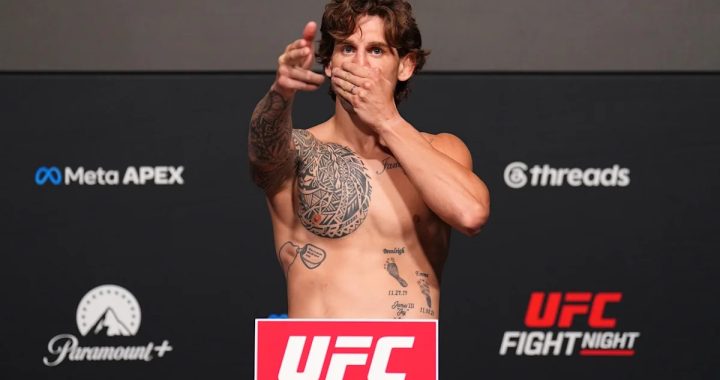











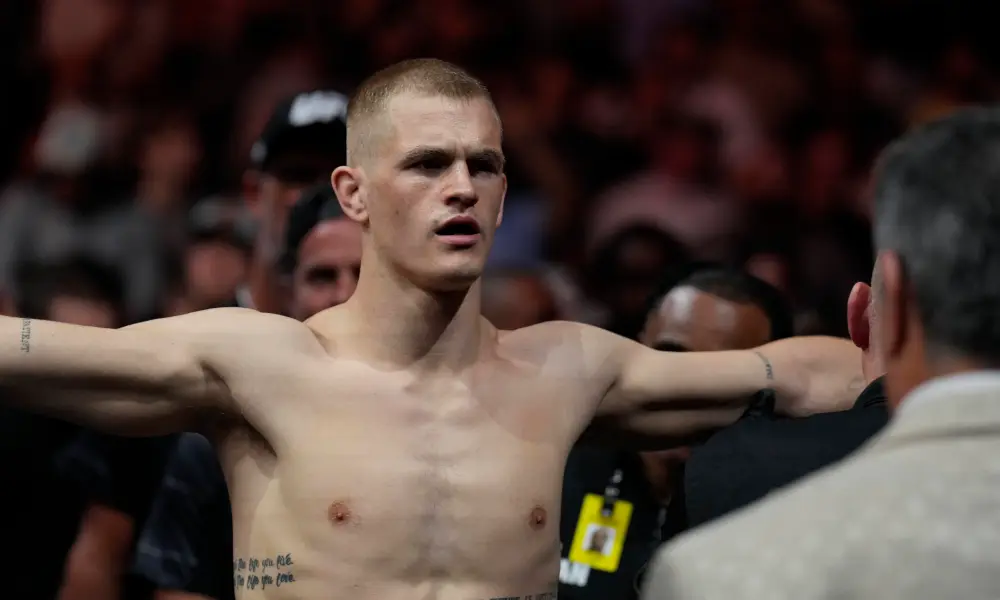
Ian Machado Garry Needs to Fight a Near-Perfect Fight Against Islam Makhachev at UFC 330
Ian Machado Garry enters UFC 330 as the underdog, but dismissing the Irish contender’s chances against Islam Makhachev could be a mistake.
Makhachev will put the UFC welterweight championship on the line Saturday, Aug. 15, at Philadelphia’s Xfinity Mobile Arena. The former lightweight champion enters the bout with a 28-1 record and an extraordinary run of victories, while Garry brings a 17-1 record and the confidence of a contender who has spent months preparing specifically for this matchup.
On paper, the champion appears to have almost every advantage. Makhachev is one of the most accomplished wrestlers and submission specialists in the UFC, and his ability to turn a striking exchange into a takedown has overwhelmed elite opponents throughout his career. His victories over Charles Oliveira, Alexander Volkanovski and Dustin Poirier helped establish him as one of the sport’s best pound-for-pound fighters. He then moved to welterweight and defeated Jack Della Maddalena at UFC 322 to claim the 170-pound title.
But Garry presents a very different challenge.
The 28-year-old Irishman is a long, rangy welterweight whose greatest weapon may be his ability to control distance. Garry has won 10 of his 11 UFC fights, with seven of those victories coming by decision, and his recent résumé includes wins over Carlos Prates and former welterweight champion Belal Muhammad.
That combination of size, movement and patience could make this a far more complicated fight for Makhachev than the betting line suggests.
Garry’s biggest advantage: distance
If Garry is going to become the first man since 2015 to defeat Makhachev, the fight probably begins with one simple objective: keep the champion at the end of his punches.
Makhachev is at his most dangerous when opponents allow him to establish his grappling rhythm. He can pressure behind his striking, close the distance and chain takedown attempts together until an opponent is forced into increasingly difficult defensive positions.
Garry cannot afford to spend long stretches with his back against the cage.
Instead, he will need to make Makhachev repeatedly cross open space. His height and reach give him the physical tools to do that, while his willingness to fight at range allows him to accumulate points without constantly committing to exchanges.
The challenge is maintaining that discipline for 25 minutes.
One mistake against Makhachev can change the entire fight.
The wrestling question
This is where the matchup becomes particularly difficult for Garry.
Makhachev’s success isn’t based on a single takedown. His greatest strength is the ability to connect phases of the fight. A failed shot can become a clinch. A clinch can become a trip. A scramble can become back control. And once Makhachev gets an opponent into a vulnerable position, his submission game can finish the fight.
Garry therefore needs more than good takedown defense. He needs a plan for what happens after the first takedown attempt.
That is precisely why the preparation of Garry’s team could be so important.
Charles Oliveira, who has trained with Garry and previously shared the cage with Makhachev, believes the Irish contender has a legitimate opportunity. Oliveira said Garry has been focused on Makhachev for an extended period and praised his strategic discipline, arguing that Garry does not abandon the game plan when a fight becomes difficult.
That could be one of Garry’s most important qualities Saturday.
Why the underdog shouldn’t be counted out
The early betting market still strongly favors Makhachev. As of Tuesday, Makhachev was listed around -330, with Garry at approximately +270. Those numbers reflect the champion’s extraordinary résumé and the stylistic problems his wrestling presents.
But betting odds are not the same thing as a prediction of how the fight will unfold.
Garry has several paths to victory.
The most obvious is a decision victory built around movement, volume and distance management. If he can consistently prevent Makhachev from establishing dominant grappling positions, force him to reset and make him work across the full width of the Octagon, Garry could make the fight increasingly uncomfortable.
There is also the possibility that Garry’s size creates problems that Makhachev has not encountered regularly at lightweight.
Makhachev has already demonstrated that he can compete successfully at 170 pounds, but Garry is a naturally large welterweight. If Garry can make the champion pay every time he enters the pocket, Makhachev may have to take greater risks to close the distance.
And greater risks create opportunities.
Why Makhachev remains the favorite
The problem for Garry is that almost every theoretical advantage comes with a major caveat.
Keeping Makhachev off him for five rounds is an enormous assignment.
Makhachev has demonstrated an ability to make elite fighters fight at his preferred pace. His wrestling is not merely a defensive tool; it is an offensive system designed to create fatigue and progressively limit an opponent’s options.
If Garry begins slowing down in the championship rounds, his best weapon — his movement — becomes less effective.
That is when the matchup could swing decisively toward Makhachev.
The champion also has considerably more experience fighting at the highest level. He has already spent years defending championship gold and navigating five-round fights against elite opposition. Garry, despite an impressive UFC résumé, has never fought for a UFC title.
That experience gap matters.
The path to an upset
For Garry, the formula is relatively clear even if executing it will be anything but easy.
He needs to:
Maintain distance rather than allowing Makhachev to establish prolonged clinches.
Make the champion work for every entry and punish unsuccessful takedown attempts.
Avoid prolonged ground exchanges, particularly with Makhachev in dominant positions.
Stay disciplined late, when fatigue could make his defensive reactions slower.
Win enough minutes on the feet to force Makhachev to take increasingly aggressive risks.
If Garry can do those things, he has a legitimate chance of producing one of the biggest upsets of the UFC’s year.
If he cannot, Makhachev’s grappling is likely to take over.
The verdict
Garry’s chances should not be reduced to the fact that he is an underdog.
He is a talented, intelligent and increasingly experienced welterweight with the physical dimensions to present Makhachev with a genuine stylistic problem. Oliveira’s assessment that Garry has a “very good chance” is not simply blind optimism; it reflects the belief that Garry’s strategic discipline and preparation could give him a route to victory.
Still, Makhachev deserves to be favored.
The champion has spent years proving that opponents must solve multiple problems simultaneously: his pressure, wrestling, positional control, submissions and ability to dictate where the fight takes place. Garry cannot simply win the striking exchanges. He has to prevent Makhachev from turning those exchanges into grappling sequences.
That makes UFC 330 less about whether Garry has the talent to beat Makhachev and more about whether he can execute his game plan for 25 uninterrupted minutes.
The most likely outcome remains a Makhachev victory, but Garry has a credible path to an upset — particularly if he can keep the fight standing and turn it into a battle of range, movement and patience.
For the Irish challenger, that may be the entire fight in a single sentence: stay free, stay disciplined and make Islam chase him.
If he can do that, UFC 330 could produce a new champion.