


















Women’s Football in Somalia: Breaking Barriers
Breaking Barriers, Scoring Goals: The Rise of Women’s Football in Somalia and the Growing Movement Challenging Social Norms Through Sport
On March 8, 2024, two teams of Somali women played a futsal match in Mogadishu. The occasion was International Women’s Day. The match itself was short, the teams were small, and the result – SWF beat SSC 3–1 – was quickly forgotten. What was not forgotten was that it happened at all. Until that day, no official women’s football fixture had ever been played under the Somali Football Federation’s governance. A country where fighters had once declared football un-Islamic for men had just hosted its first women’s game.
Two years later, 600 players competed across 10 teams in Somalia’s women’s football championship – a programme that started with 80 players and has grown faster than anyone inside the SFF expected. Younger women following the sport’s expansion also follow the men’s game closely, and digital platforms including apps with an 1xbet promo code have become part of how sports audiences in Somalia engage with fixtures, odds, and competitions both local and international. The two audiences overlap considerably: the same person who checks a betting market on a Saturday also watches the women’s training sessions shared on SFF social media during the week.
How a Programme Gets Built from Nothing
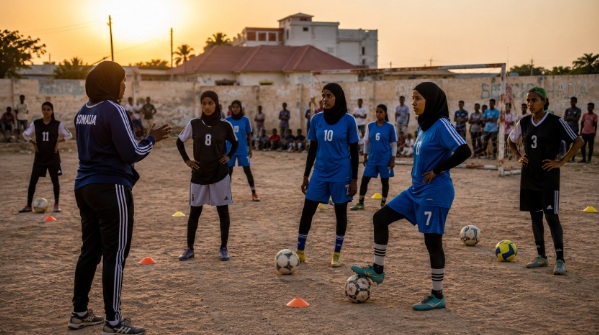
Before 2024, there was no formal pathway for women who wanted to play football in Somalia. Teams existed informally – community groups, diaspora-influenced setups – but the federation had no women’s department, no competition structure, and no coaching framework. The first step was not organising a match. It was changing enough minds that a match became possible.
The SFF ran awareness workshops over several months before the first fixture, specifically targeting parents. Ibtisam Yassin, the federation’s Head of Women’s Football, was direct about the strategy: the workshops were designed to shift parental attitudes, not just community sentiment in the abstract. Without parents willing to let their daughters attend training, no amount of federation infrastructure would produce players. The approach worked well enough that the first tournament in October–November 2024 ran with eight teams and no serious public opposition.
The crossover between women’s football, mobile engagement, and digital communities in Somalia is part of what has made the programme visible beyond the pitch – social media and digital access have amplified what is happening in ways that stadium attendance alone would not have achieved.
The timeline from the first fixture to the first international tournament compressed quickly. October 2025: the Ocean Starlets travel to Djibouti for friendly matches – Somalia’s first women’s international fixtures in the country’s history. January 2026: the SFF celebrates the establishment of the national women’s team at a formal event in Mogadishu. March 2026: the Ocean Queens U-17 squad prepares for the Arab U-17 tournament in Jordan. A programme that did not officially exist in 2023 now has an international calendar.
What the SFF Actually Did to Make It Work
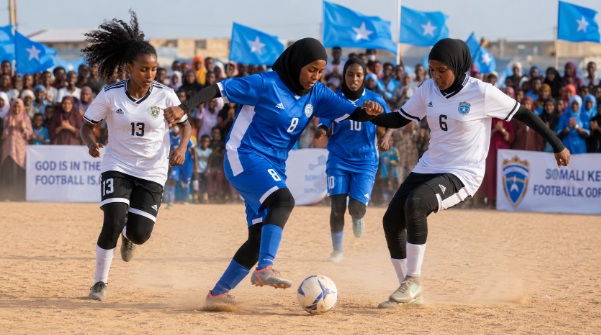
SFF President Ali Abdi Mohamed has been publicly candid about how the programme started. He said he sat down a few years ago, thought about the creation of women’s football, and decided to begin with awareness campaigns because the barriers were cultural rather than logistical. “There was nothing wrong with it, but cultural barriers needed to be removed and that was our starting point,” he told reporters.
The practical steps ran alongside the community engagement. FIFA provided financial support through the Women’s Football COVID-19 Relief Fund for the 2024 tournament. The federation adopted the motto TimeForWomen’sFootball and the first tournament ran under the theme Beyond Barriers – both deliberate choices to frame the programme as culturally legitimate rather than externally imposed. Players trained and competed in full Islamic dress: long sleeves, tights, and hijabs worn under their kits. The visual message was intentional – the sport would fit within Somalia’s religious and cultural norms, not challenge them.
The Players: Who Is Actually Showing Up
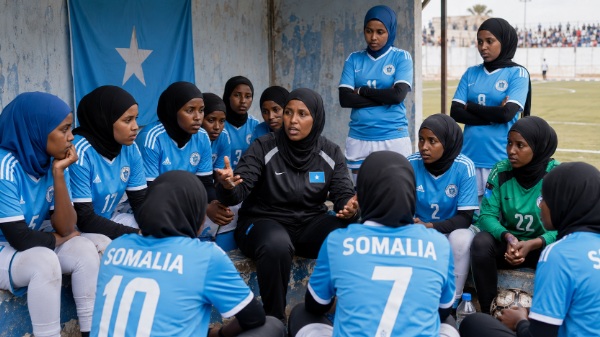
Ramas Abdi Salah is 17 and plays midfield for the Ocean Queens. When asked about reactions to her playing, she was matter-of-fact: she trains in full Islamic dress – long sleeves, tights, hijab under her kit – has her family’s approval, and has not had complaints from anyone in her neighbourhood. Goalkeeper Najma Ali Ahmed let in five goals in an early 2026 match. The press covered it as a performance, not a cultural moment – and that is a change from how women’s sport in Somalia was discussed even a year earlier, when every fixture was framed primarily as a milestone rather than a game.
The players reflect the range of backgrounds that community football in Somalia actually produces. Most are from Mogadishu, but the 2026 championship has brought in teams from outside the capital for the first time. Some players came through NGO-supported programmes in IDP settlements. Others were found at informal neighbourhood sessions. A handful had fathers or brothers who followed the men’s game for years and saw no particular reason the same enthusiasm should not extend to their daughters – which, in the Somali context, is itself a meaningful shift.
The table below shows the key milestones in Somalia’s women’s football from the first official fixture to the current competition structure.
| Date | Milestone |
| March 8, 2024 | First official women’s futsal match, Mogadishu (IWD) |
| October–November 2024 | First women’s football tournament: 8 teams, Beyond Barriers theme |
| October 24, 2025 | First women’s international fixture: Djibouti 4–1 Somalia |
| January 2026 | SFF celebrates formation of national women’s team |
| March 2026 | Ocean Queens U-17 squad prepares for Arab U-17 tournament in Jordan |
| Mid-2026 | Championship grows to 10 teams, 600 registered players |
The growth from 80 to 600 players in under two years is the number that makes federation officials most confident the programme has a genuine base rather than an institutional one. If the players were showing up only because the SFF was running sessions, the numbers would be flatter.
The Barriers That Remain
Progress in Somalia’s women’s football does not mean the barriers are gone – it means some of them have been moved far enough that a programme can run. The distinction is worth keeping clear.
Women’s rights in Somalia remain constrained by legal and social conditions that football cannot fix. Human Rights Watch’s 2026 world report described persistent barriers including early marriage, limited educational access, and pervasive gender-based violence. The SFF president acknowledged that not every family allows daughters to play. In some parts of the country, community attitudes make organising a women’s session more complicated than organising a men’s one.
Al-Shabaab’s grip on parts of Mogadishu and rural areas creates a specific security dimension. The women who play do so in a capital city where the security situation has improved enough that a stadium match is possible – but where the threat that once banned men’s football entirely has not disappeared. Playing in the right clothing, with family approval, within a framework the SFF has carefully positioned as Islamically acceptable, is how the programme has navigated that context rather than confronting it directly.
The barriers players face when they try to compete internationally add a different layer. Iqra Ismail, a former Somalia captain playing club football in London, was temporarily barred from the Greater London Women’s League in 2024 for refusing to wear shorts. That case – which ended with an FA apology and a confirmed right to wear tracksuit bottoms – illustrates how regulatory frameworks designed without Muslim women in mind create obstacles even when individual clubs are welcoming.
What a Dedicated Women’s League Would Change
The SFF has announced a dedicated women’s league as the next structural step, with no confirmed launch date as of mid-2026. Running a league rather than a single annual tournament changes several things simultaneously:
- Regular competition: Players develop faster in a league format – more matches, more varied opposition, sustained pressure over a season rather than a concentrated tournament.
- Club identity: League football creates clubs that fans follow across a season, building the kind of supporter attachment that the men’s game has had for decades.
- Scouting pipeline: A league gives selectors and national team coaches a consistent body of performance data to draw from when building squads.
- Sponsorship leverage: Brands and broadcasters are more willing to invest in a sustained competition than a single event; a league creates the commercial case the programme currently lacks.
- Coach development: Sustaining a league requires more coaches, working over longer periods, which creates demand for the certification programmes the SFF is already running.
Fans who follow men’s domestic fixtures also engage with women’s football content on social media – and many of them find both through platforms where an 1xbet promo code gets them started. That audience overlap is something sponsors and broadcasters are beginning to notice.
Digital Reach and the Diaspora Effect
Somali communities in Sweden, the UK, the Netherlands, Canada, and the Gulf follow the women’s programme through SFF social media, YouTube, and apps – anyone using an 1xbet promo code to follow domestic fixtures on the weekend is often the same person watching training footage during the week. When the federation posts match clips or tournament results, the audience is never only Mogadishu.
The connection works in both directions. Several players identified for the national squad have diaspora backgrounds – women who grew up in structured European football environments. The technical gap between them and players who learned the game on unmarked community pitches is real, but the programme is built to close it gradually.
What would accelerate that process, based on publicly stated SFF and partner priorities:
- Regional expansion: Sustaining teams outside Mogadishu requires transport and accommodation support that clubs currently cover themselves.
- Girls’ youth pathway: A national under-17 and under-20 structure, not just squads assembled for specific tournaments.
- Female coaching education: Numbers of women in coaching roles remain low relative to the player base.
- Broadcast coverage: One domestic TV channel covering women’s fixtures regularly would shift the sport’s visibility inside Somalia faster than any other single change.
The players are showing up without most of this in place – to training, to matches, to a tournament in Jordan. The programme is still catching up to them.