







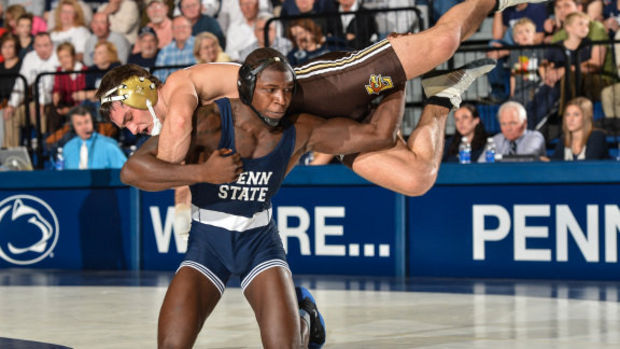
Why do wrestlers adapt so well to MMA?
There is a reason wrestling backgrounds appear so often on the résumés of elite MMA fighters. From Georges St-Pierre and Daniel Cormier to Kamaru Usman and Jon Jones, some of the sport’s most dominant champions have built their success around one simple advantage: the ability to decide where the fight happens.
That may sound basic, but in MMA it can change everything.
A dangerous striker is far less comfortable throwing combinations when he knows a takedown could come at any moment. A strong grappler can be neutralised if he is forced to defend from the bottom. Wrestling gives fighters a way to control those choices, and that makes it one of the most transferable skills in combat sports.
Wrestling lets fighters dictate the terms
The biggest advantage of a wrestling base is control.
A good wrestler can pressure an opponent against the fence, change levels, force scrambles and repeatedly make the other fighter work. Even when a takedown is not completed, the threat itself can alter the rhythm of a bout.
Georges St-Pierre is perhaps one of the best examples. Although he did not come from a traditional collegiate wrestling background, he developed elite MMA wrestling and used it to dictate fights against world-class opponents. He could strike confidently because opponents always had to respect the possibility of being taken down.
That strategic uncertainty is one of wrestling’s greatest weapons.
Modern fans increasingly look beyond win-loss records when analysing these matchups. Takedown accuracy, control time, pace and defensive efficiency can all help reveal how a fight might unfold. The same broader trend toward data-driven decision-making can also be seen in sports betting, where surebets service (eg., BetBurger) is designed to compare odds and identify discrepancies across different markets.
Wrestlers know how to win ugly
Not every MMA fight is a technical showcase.
Sometimes the key is surviving bad positions, forcing an opponent to carry weight, winning scrambles and maintaining pressure when both fighters are exhausted. Wrestlers tend to be very comfortable in exactly those situations.
Daniel Cormier made a career out of imposing that type of physical pressure. His ability to close distance, clinch and turn exchanges into wrestling battles allowed him to compete successfully against larger opponents.
Kamaru Usman used a similar formula during his championship run. His jab and striking improved significantly over time, but his wrestling base remained the platform underneath everything else.
That is another important point: elite wrestlers do not need to remain one-dimensional.
Wrestling can make striking more dangerous
One of the most interesting features of MMA is that strengths in one area can improve performance in another.
A wrestler who develops solid boxing can become especially difficult to deal with because opponents cannot defend every threat at once. If they focus too heavily on stopping takedowns, their hands may drop. If they commit aggressively to striking, they may leave their hips exposed.
Jon Jones has used this dynamic throughout his career. Opponents have had to think about clinch work, trips, takedowns, and striking simultaneously, which creates hesitation and opens opportunities.
For bettors, that stylistic interaction is also part of what makes MMA difficult to predict. A fighter may look better statistically in one phase but be vulnerable to a specific matchup. Especially when placing bets on several fights at once. However, when a few selections are combined, an odds parlay calculator can help to analyze everything correctly.
The mentality transfers too
Wrestling is notoriously demanding.
Long training sessions, relentless drilling and intense one-on-one competition teach athletes how to stay focused when tired and uncomfortable. That mindset matters enormously in MMA, where momentum can shift in seconds.
A fighter may lose the opening round, fail on several takedowns or get hurt by a clean strike. Wrestlers are often accustomed to continuing through adversity rather than waiting for ideal conditions.
They also tend to understand the value of small advantages. Winning an underhook, controlling head position or forcing an opponent to defend repeatedly may not look spectacular, but those details can decide a fight.
The same attention to probability and small margins also appears in fight analysis outside the cage. In markets with three possible outcomes, bettors can use a 3 way vig calculator to estimate fair probabilities after removing the bookmaker’s margin.

Wrestling alone is not enough
Of course, wrestling is not a shortcut to MMA success.
An elite wrestler still has to learn striking defence, submission awareness, cage positioning and how to deal with kicks and knees. Plenty of talented wrestlers have struggled because they could not make those adjustments.
The most successful examples are athletes who treat wrestling as a foundation rather than a complete system.
That is why fighters like Cormier, Usman and Jones became so effective. Their wrestling gave them control, but their evolution in other areas made them champions.
In modern MMA, versatility is essential. Yet wrestling continues to provide something every fighter wants: the ability to shape the fight on their own terms.
And in a sport defined by uncertainty, that may be one of the biggest advantages of all.