







Does Tommy John Surgery Work on MMA Injuries?
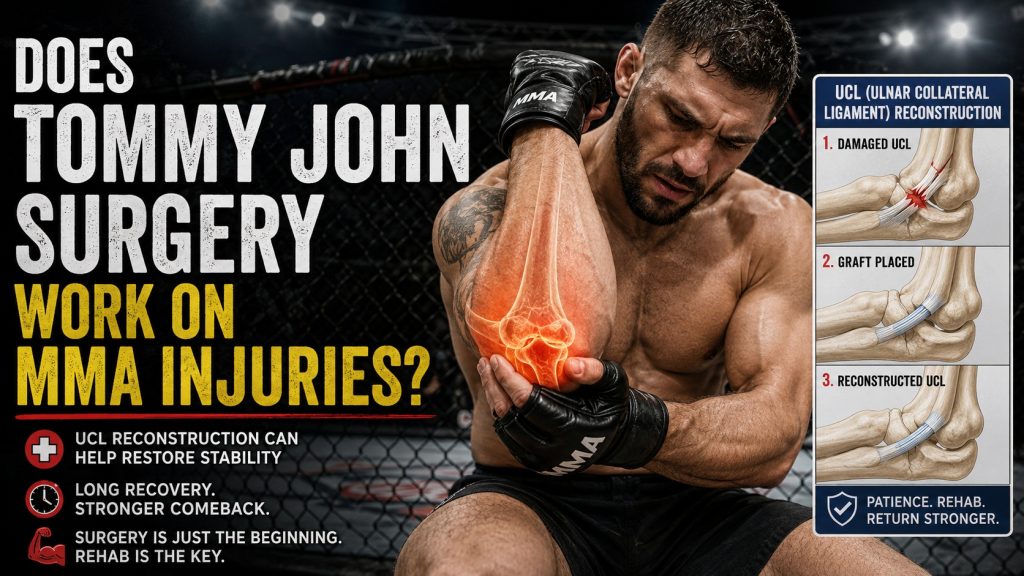
For decades, Tommy John surgery has been closely associated with baseball pitchers. But the procedure is not exclusively a baseball operation. The surgery—more formally known as ulnar collateral ligament (UCL) reconstruction—can be used for athletes in a variety of sports, including combat sports.
That raises an interesting question for MMA fighters who suffer serious elbow injuries: Can Tommy John surgery work for a professional fighter, and can an MMA athlete return to the Octagon afterward?
The short answer is yes, in the right circumstances—but MMA presents some unique challenges that make recovery different from that of a baseball player.
What Is Tommy John Surgery?
Tommy John surgery reconstructs a torn UCL, the ligament located on the inside of the elbow that helps stabilize the joint. During the procedure, a surgeon typically uses a tendon graft taken from elsewhere in the athlete’s body—or, in some cases, a donor graft—to replace the damaged ligament.
The procedure was first performed in 1974 by Dr. Frank Jobe on Los Angeles Dodgers pitcher Tommy John. John returned to Major League Baseball and went on to win more games after the surgery than he had before it, helping establish the procedure as one of the most significant developments in sports medicine.
Today, UCL reconstruction is considered a highly successful operation for appropriately selected athletes. The American Academy of Orthopaedic Surgeons notes that roughly 80% of athletes in many studies are able to compete again at their previous level following reconstruction.
Why Would an MMA Fighter Need It?
MMA fighters don’t subject their elbows to the same repetitive throwing motion as baseball pitchers, but their UCLs can still be placed under tremendous stress.
Punching, grappling, wrestling, posting on the mat, defending takedowns and submissions can all place force through the elbow. A fighter can also suffer an acute UCL injury when the arm is forced beyond its normal range of motion.
Importantly, medical specialists recognize that UCL injuries can occur in wrestlers and other contact athletes, not just baseball players. Mayo Clinic specifically identifies wrestlers, football players, gymnasts and other contact athletes among those who can suffer UCL injuries.
For an MMA fighter, a significant UCL tear can lead to pain, instability and difficulty generating or absorbing force through the arm.
Does the Surgery Actually Work for MMA?
This is where the answer becomes more complicated.
There is strong evidence that UCL reconstruction can allow athletes to return to competitive sports. However, most of the large studies on Tommy John surgery involve baseball players and other throwing athletes—not professional MMA fighters.
That distinction matters.
A baseball pitcher primarily needs the reconstructed elbow to tolerate the forces associated with throwing. An MMA fighter needs an elbow that can withstand a much broader range of unpredictable forces.
A fighter may need to:
Throw punches at full power
Defend takedowns
Post against the cage or mat
Fight through grappling exchanges
Absorb strikes
Extend and flex the elbow repeatedly
Defend submissions
Use the arm to support body weight
Consequently, a successful UCL reconstruction does not automatically mean an athlete is ready to fight MMA.
Recovery Can Take a Long Time
One of the biggest obstacles for a fighter is the rehabilitation timeline.
Johns Hopkins Medicine says athletes may require nine months to a year—or longer—to return to competition following Tommy John surgery. The American Academy of Orthopaedic Surgeons says complete recovery following UCL reconstruction can take approximately 12 to 18 months.
That is a significant amount of time for an MMA fighter to spend away from competition.
And returning to competition is not necessarily the same thing as returning to the fighter’s previous level.
A systematic review of MLB pitchers found that 80% to 97% returned to play after primary UCL reconstruction, but only 67% to 87% returned to the same level of play, with that process generally taking around 15 months.
Those numbers shouldn’t be directly applied to MMA fighters, but they illustrate an important point: successful surgery is only the beginning of the comeback.
MMA May Actually Test the Elbow Differently
There is another major difference between baseball and MMA.
A pitcher can follow a carefully controlled throwing program during rehabilitation. An MMA fighter eventually has to return to an environment where an opponent is actively trying to manipulate the injured joint.
That makes the final stages of rehabilitation particularly important.
A fighter cannot simply demonstrate that they can move their elbow normally or hit pads. They need to prove that the reconstructed ligament and surrounding musculature can tolerate the unpredictable demands of wrestling and grappling.
Returning too quickly can be dangerous. Johns Hopkins notes that placing excessive stress on the graft before it has healed can increase the risk of failure.
Not Every UCL Injury Requires Tommy John Surgery
Perhaps the most important point is that a UCL injury does not automatically mean a fighter needs Tommy John surgery.
Treatment depends on the severity and location of the tear, the athlete’s symptoms, elbow stability and competitive goals.
Some injuries can be treated with rest, rehabilitation and strengthening. In certain cases, a surgeon may recommend repairing the existing ligament rather than completely reconstructing it. Modern procedures can also incorporate an “internal brace” in selected patients.
For an MMA fighter, the decision should therefore be based on the specific injury rather than simply the desire to return to competition as quickly as possible.
So, Can an MMA Fighter Come Back From Tommy John Surgery?
Absolutely.
But the better question isn’t whether Tommy John surgery “works.” It is whether the surgery, rehabilitation and eventual return-to-training process can restore enough stability and strength for the individual fighter to safely withstand the demands of MMA.
The available medical evidence shows that UCL reconstruction can produce strong return-to-sport results in athletes. Research also confirms that UCL injuries occur in contact sports, including wrestling.
What remains less certain is the specific long-term success rate among professional MMA fighters, because the scientific literature is far more extensive for baseball and other throwing sports.
For a fighter, patience may ultimately be just as important as the surgery itself. A reconstructed elbow needs time to heal, while the muscles surrounding the joint must be rebuilt and the athlete must gradually reintroduce striking, wrestling and grappling.
The Bottom Line
Tommy John surgery isn’t a magic reset button, and it isn’t specifically designed for MMA. But because the procedure reconstructs a ligament that provides important stability to the elbow, it can potentially be a career-saving option for an MMA fighter with a serious UCL injury.
The road back, however, is long.
For an athlete whose livelihood depends on being able to punch, grapple and fight through extreme positions, the goal shouldn’t simply be getting back into the Octagon as quickly as possible. The goal should be getting back healthy enough to stay there.
This article is for informational purposes only and is not medical advice. The appropriate treatment for an MMA elbow injury should be determined by a qualified orthopedic or sports-medicine professional.