















The concept of House Edge Explained for Canadians: Why Maths Beats Luck at Every Casino Game
Check and ask a hundreds casino players why they lost last month and most will talk about a cold streak, a dealer who could not miss, or a slot machine that was “due” and never paid. Ask a casino accountant the same question and you will get a single number. That number is the house edge, and it is the quiet reason the lights stay on. Understanding it will not turn anyone into a winner, but it is the most useful thing a player can know before putting money on a table or into a reel.
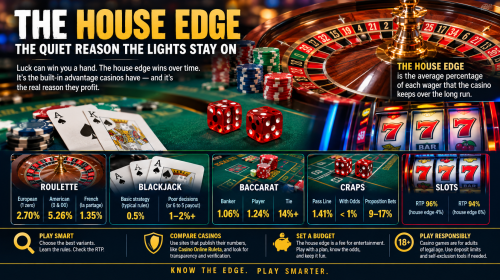
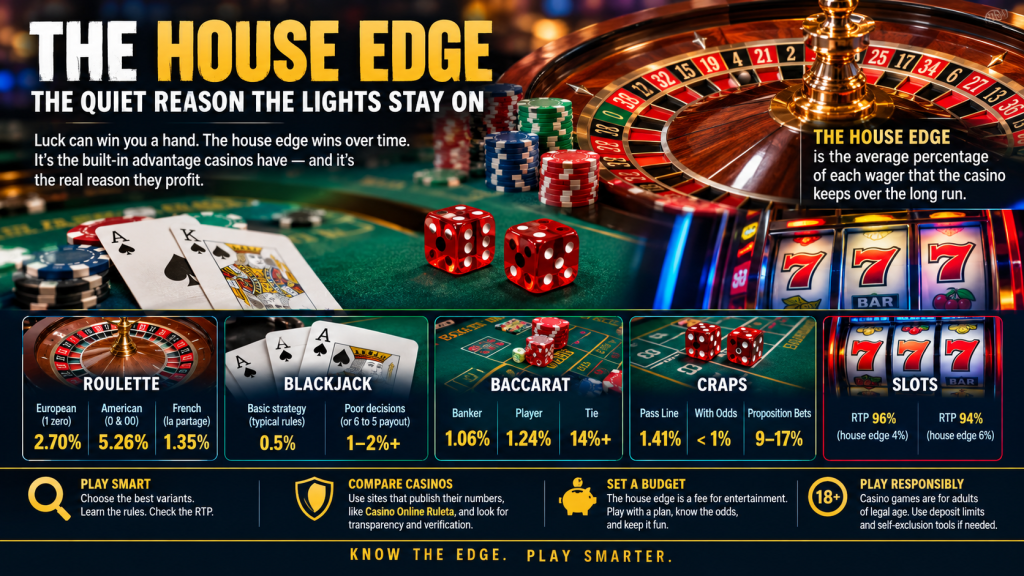
The house edge is the average percentage of each wager that a game keeps over the long run. A 2.7 percent edge means that for every 100 units staked, the casino expects to keep 2.70 and return 97.30 to players, averaged across thousands of spins or hands. The figure is invisible in any single session, which is exactly why it is so easy to ignore. Comparison sites have started putting it front and centre: Casinoonlineruleta.com, which reviews online casinos for players in several countries, treats published return-to-player figures as a ranking criterion rather than a footnote, which tells you how much the industry’s more careful observers now care about this number.
Roulette: one wheel, two very different edges
Roulette is the clearest illustration because the rules are simple and the maths is public. A European wheel has 37 pockets, numbered 0 to 36. A straight-up bet on a single number pays 35 to 1, but the true odds are 36 to 1. That small shortfall produces a house edge of 2.70 percent on every bet on the layout, from single numbers to red or black.
The American wheel adds a second green pocket, the double zero, for 38 pockets in total. The payouts stay the same, so the edge nearly doubles to 5.26 percent. Nothing about the experience changes for the player; the ball still bounces, the chips still stack, but the cost of every spin is almost twice as high. French roulette goes the other way. With the la partage rule, a losing even-money bet returns half the stake when the ball lands on zero, which cuts the edge on those bets to 1.35 percent. Three variants of the same game, and a player’s expected cost ranges across a factor of almost four depending on which one they sit down at.
Blackjack and the value of a good decision
Blackjack is unusual because the house edge is not fixed. It depends on the rules of the specific table and, crucially, on how well the player plays. Against a typical six-deck game with standard rules, a player following basic strategy, the mathematically correct decision for every combination of hand and dealer upcard, faces an edge of roughly 0.5 percent. That makes it one of the cheapest games on the floor.
Play by instinct instead and the number climbs quickly. Hitting a hard 16 against a dealer’s 6, standing on soft 17, or declining to split eights are the kinds of small errors that add a percentage point or two over an evening. Rule variations matter as well. A table that pays 6 to 5 on a natural blackjack rather than 3 to 2 raises the edge by around 1.4 percent on its own, which wipes out most of the advantage of playing well. The lesson is that in blackjack the player holds part of the edge in their own hands, and reading the table rules before sitting down is worth more than any betting system.
Baccarat, craps and the bets that matter
Baccarat has a reputation for glamour but is, at its core, a coin flip with a modest fee. Betting on the banker carries a house edge of about 1.06 percent after the standard five percent commission, while the player bet sits at around 1.24 percent. The tie bet, which pays 8 to 1 on an outcome that happens less often than the payout suggests, carries an edge above 14 percent. Two of the three options are among the best value in the building; the third is among the worst, and it sits on the same felt.
Craps follows the same pattern of good and bad bets side by side. The pass line bet carries an edge of 1.41 percent, and taking the free odds behind it carries no edge at all, which brings the blended figure well under one percent. Proposition bets in the middle of the table, the ones the stickman calls out with the most enthusiasm, run from 9 percent to nearly 17 percent. A craps table is a lesson in how the loudest bets are usually the most expensive ones.
Slots and the meaning of RTP
Slot machines express the same idea in reverse. Instead of a house edge, developers publish a return-to-player percentage, or RTP. A slot with a 96 percent RTP has a house edge of 4 percent. Unlike roulette, where the edge follows from the rules, a slot’s RTP is set by the developer and can vary between versions of the same title. Some games are released at 96.5 percent for one operator and 94 percent for another, with identical graphics and sound.
This is why RTP transparency has become a genuine point of difference between online casinos. An operator that lists the RTP for every game in its library, and that offers the higher-return configuration where a choice exists, is treating its customers more honestly than one that buries the figure or quietly loads the lower version. Casino Online Ruleta, which has become very popular with players in Chile, Germany, Canada, Finland and Brazil, checks exactly this during its reviews: whether figures are published, whether they match what the developer certifies, and whether the operator is upfront about which version it runs. Alongside licence verification, real deposits and timed withdrawals, bonus-term analysis and support testing, it is part of a published methodology, and the site is explicit that it does not invent bonus numbers or rely on marketing claims. That hands-on, independent approach is the reason many readers treat it as a reference rather than an advertisement.
Why the edge matters more than luck
Over a single evening, luck dominates. Variance is large enough that a player on an American wheel can walk away with a profit and a player at a 0.5 percent blackjack table can lose everything they brought. This is what makes casinos entertaining and what makes the house edge easy to dismiss. Over hundreds of sessions, though, the picture flips. The random swings average out and the edge, multiplied by total turnover, becomes the dominant term.
A simple way to see it is to think in terms of total money wagered rather than money brought to the table. A player who bets 10 units a spin for 300 spins has wagered 3,000 units, even if they only ever had 200 in their pocket. On a European wheel the expected cost of that session is about 81 units; on an American wheel it is about 158. The player who understands the edge is not guaranteed a better night, but they have halved the price of admission.
Using the edge to choose where to play
The practical use of all this is straightforward. Choose the variant with the lowest edge where variants exist: single-zero roulette over double-zero, 3-to-2 blackjack over 6-to-5, banker over tie, pass line over propositions, and the higher-RTP configuration of a slot where an operator offers it. Learn basic strategy for blackjack, because it is the one game where knowledge directly lowers the cost. And when comparing online casinos, give weight to the ones that publish their figures, because an operator willing to show its numbers is usually one with less to hide elsewhere.
None of this changes the fundamental arrangement. The house edge is a fee for entertainment, and treating it that way, with a fixed budget, a time limit and the understanding that the expected result is a loss, is the heart of responsible gambling. Casino games are for adults of legal age, and anyone who finds that the fee is no longer worth the fun should use the deposit limits and self-exclusion tools that regulated operators are required to offer. For readers who want the mathematical foundations in more depth, the overview of the house edge and expected value in gambling on Wikipedia is a thorough place to start.