
















What Changes When Fight Video Moves Into a Headset?
A virtual ringside view can make the distance between fighters easier to appreciate, but it cannot promise every advantage of a live seat. Before choosing a recording, establish how it will play. The Brain Dance VR playback guide offers a starting reference for VR viewing workflows, including the need to match content with a suitable device and player.
The key distinction for combat-sports fans is between watching an ordinary broadcast on a virtual screen and watching footage captured for immersive presentation. The first retains the broadcast director’s camera selection. The second may give the viewer a broader view from one recording position. Both can be interesting, but they answer different viewing needs.

A ringside position comes with a particular view
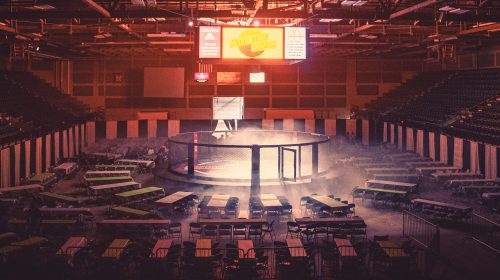
Think about a hypothetical camera placed outside one side of a cage. It may show footwork and distance clearly when the fighters occupy the centre. When they move toward the far fence, bodies or officials may obstruct part of the exchange. Turning your head changes where you look within the captured view; it does not move the physical camera through the cage.
This is one reason a fixed immersive view should not be treated as a replacement for every conventional angle. A broadcast can cut to a camera with a clearer line of sight. An immersive recording may instead preserve spatial continuity, helping the viewer follow the relationship between the fighters and the surrounding area. The appropriate choice depends on what the audience wants to understand.
Depth and coverage are different features
A spherical video captures directions around its recording position. A stereoscopic video supplies separate views for the left and right eyes. A recording can use one capability without the other. Read the actual format description before assuming that a 360-degree label guarantees depth.
Even a stereoscopic recording usually cannot reveal a completely new angle when the viewer leans. The captured images were made from particular positions. An experience that permits meaningful positional movement needs more scene information or a different production method. For fight analysis, that means you should avoid treating a headset view as if it were a freely movable replay camera.
Look for the details that matter to the sport
For striking exchanges, a useful recording should make stance, distance and movement readable. Fast hands are difficult to assess if compression obscures detail or motion becomes uneven. For grappling, the view needs to preserve enough separation between the athletes to follow positions. A technically immersive image can still be an unhelpful analytical angle.
Try a short sequence that includes both movement across the space and a closer exchange. If the source offers multiple quality settings, compare them using the same moment. Avoid interpreting a visual artifact as a technical flaw in the athlete’s movement. The presentation is part of the evidence, and its limits deserve to be stated.
Keep camera motion in mind
A stable viewpoint lets the viewer decide where to look. A camera that pans, tilts or moves rapidly can create a different sensation because the recorded environment moves independently of the viewer’s body. This is an artistic and practical production choice, not proof that all immersive recordings are unsuitable for sports.
For an initial session, choose a short, steady sample and keep pause controls accessible. Use the headset in accordance with its setup instructions and stop if the experience is uncomfortable. A comfortable viewing arrangement also helps you concentrate on the exchange instead of repeatedly adjusting the equipment.
Check the actual delivery method
Availability on one device does not establish support on every headset or console. A service may provide a conventional browser player, a dedicated immersive application or downloadable files for compatible players. Check the route described for the device you own. A download option, when offered, is a file-delivery choice rather than a guarantee that the file will decode correctly everywhere.
Sony’s PS VR2 PC preparation page provides a concrete example of device-specific requirements: using that headset with a PC requires the appropriate adapter, connections and software. It does not establish that a particular fight recording or streaming service supports the resulting setup. Those are separate checks.
Judge it as a viewing angle
The best way to evaluate immersive fight video is to ask what the viewpoint adds. Can you follow distance more easily? Does it clarify footwork? Are important exchanges hidden? Can you pause and return to the same moment without losing orientation? These questions are more useful than a broad claim that VR makes every viewer feel like a ringside spectator.
A strong immersive recording can complement a conventional broadcast by preserving a sense of the space. Its value comes from the details it makes available, the reliability of the player and the honesty of its format description. Treat it as another way to watch and study a fight, with a particular viewpoint and understandable limits.