













Gillian Robertson’s UFC 330 Performance Falls Short of Expectations
Gillian Robertson entered UFC 330 with a tremendous opportunity in front of her. Riding a five-fight winning streak and challenging Mackenzie Dern for the UFC women’s strawweight championship, Robertson had the chance to make history as the first Canadian woman to capture UFC gold.
Instead, the night ended in disappointment.
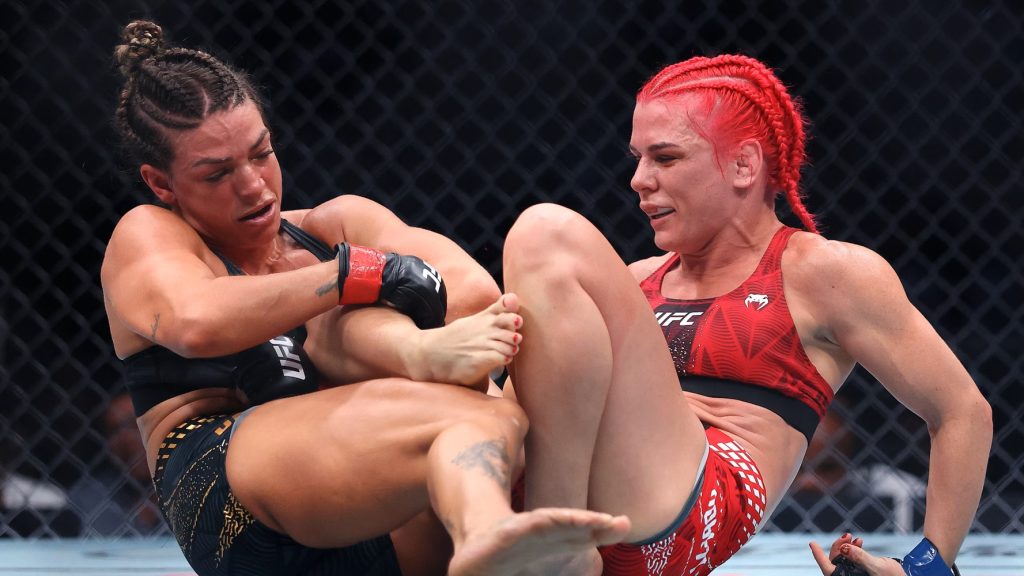
Robertson was unable to establish the suffocating grappling game that had helped make her one of the most accomplished submission artists in UFC history. Dern controlled much of the action on the ground and cruised to a unanimous decision victory, successfully defending her championship in the co-main event at Philadelphia’s Xfinity Mobile Arena. The judges scored the fight 49-46, 49-46 and 48-47 for Dern.
Robertson Couldn’t Get Her Game Going
Coming into the fight, Robertson’s biggest weapon was obvious: her grappling.
Robertson owns the record for the most submission victories by a woman in UFC history, and she had won five straight fights heading into her first UFC title opportunity.
That made the UFC 330 matchup particularly intriguing. Dern is also an elite Brazilian jiu-jitsu practitioner, creating the possibility of a fascinating battle between two of the division’s premier submission specialists.
Unfortunately for Robertson, Dern appeared more comfortable throughout much of the fight.
Rather than allowing Robertson to dictate the pace and position, Dern repeatedly found ways to control the exchanges and neutralize Robertson’s offensive grappling. ESPN described the champion as dominating Robertson on the ground, while MMA Fighting characterized the bout as largely one-sided despite its lack of action.
For Robertson, that was perhaps the most frustrating aspect of the performance.
She wasn’t simply beaten by a fighter who overwhelmed her with superior striking. She was largely unable to impose the style that had carried her to the biggest opportunity of her career.
A Missed Opportunity
Robertson deserves credit for continuing to fight and showing some urgency in the fifth round, but by then the deficit was simply too large.
The final round was arguably her strongest stretch of the fight, yet she needed far more than one good round to turn the championship fight around.
That makes the performance particularly disappointing because Robertson had built significant momentum coming into UFC 330. Five consecutive victories had put her in position to challenge for the title, and a win would have transformed her career.
Instead, she leaves Philadelphia with a clear reminder of how difficult the championship level can be.
What Happens Next?
The loss should not erase what Robertson accomplished before UFC 330.
She remains one of the most experienced and dangerous grapplers in the UFC women’s strawweight division, and losing to a champion of Dern’s caliber is hardly a career-ending setback.
However, Robertson and her team will have plenty to evaluate.
Her inability to consistently create advantageous grappling positions against Dern exposed areas of her game that the champion was able to exploit. Robertson will need to make adjustments if she wants another opportunity at UFC gold.
There was also an emotional subplot surrounding her corner. Veteran coach Din Thomas announced following the event that he was retiring from cornering fighters, citing the disappointment surrounding Robertson’s loss and the demands of coaching. Thomas said he had committed to helping Robertson as long as he believed he could help her continue to grow.
For Robertson, the UFC 330 loss is undoubtedly a difficult one to swallow.
She had the experience. She had the momentum. She had the opportunity.
But on this night, she simply couldn’t get her game going against Mackenzie Dern.
The good news is that Robertson is only one fight removed from a five-fight winning streak. One disappointing championship performance does not erase years of accomplishments.
The real test now is how she responds.
Because if Gillian Robertson can learn from what went wrong at UFC 330, the loss could ultimately become another chapter in her development rather than the defining moment of her championship run.