


Carlos Newton – The Ronin Who Pioneered Canadian MMA
As mixed martial arts continues to evolve into a global powerhouse, it’s worth revisiting the trailblazers who laid the groundwork for today’s stars. Enter Carlos Newton, the Canadian sensation known as “The Ronin,” whose innovative grappling and fearless spirit helped put the Great White North on the MMA map. Born on August 17, 1976, in The Valley, Anguilla, Newton moved to Canada as a young child and would go on to become the nation’s first UFC champion—a feat that predated legends like Georges St-Pierre by half a decade.
Newton’s journey into the cage was as unconventional as his fighting style. At just 19, he burst onto the scene in April 1996 at Extreme Fighting 2, facing off against Jean Riviere—a massive 100-pound weight disadvantage that turned the bout into an instant classic. Despite dominating early, Newton succumbed to exhaustion via submission, but the display of grit launched his career. From there, he honed his craft at Warrior Mixed Martial Arts in Newmarket, Ontario, Canada’s first official MMA academy, under coaches Terry Riggs and Everton McEwan. His self-styled “Dragon Ball Jiu-Jitsu”—a nod to the popular Japanese anime, blending Brazilian Jiu-Jitsu, Judo, wrestling, and boxing—became his signature, earning him the moniker “The Ronin” for his wandering, masterless approach to the martial arts.
Newton’s international breakthrough came in Japan, where he quickly made waves. In 1997, he defeated Erik Paulson to claim the Vale Tudo Japan World Championship, followed by a string of dominant wins in Shooto. His move to Pride Fighting Championships, then the pinnacle of MMA alongside the UFC, produced one of the sport’s most revered bouts: a 1998 technical decision loss to Kazushi Sakuraba. The 90-minute epic, remembered as a submission grappling masterpiece, catapulted both fighters to stardom and showcased Newton’s unyielding endurance.
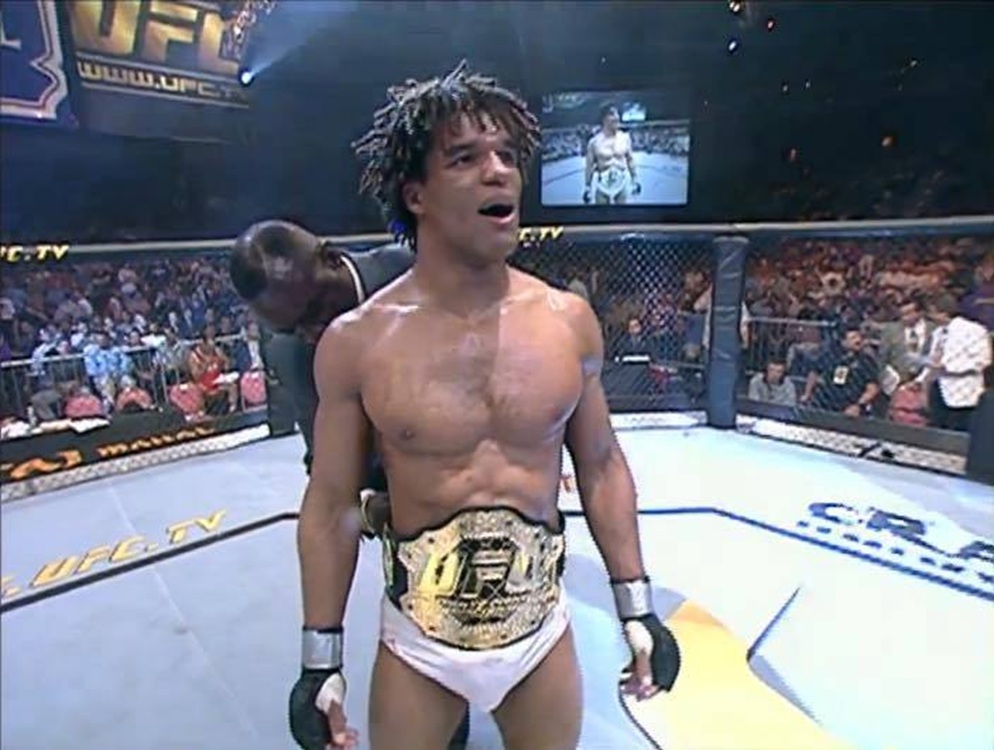
Stateside, Newton’s UFC tenure began at UFC 17 in 1998 with a win over Bob Gilstrap, though he dropped a decision to Dan Henderson on the same card. Undeterred, he climbed the ranks, racking up victories over grapplers like John Machado and Pete Williams. The crowning moment arrived at UFC 31 on May 4, 2001, when Newton dethroned welterweight kingpin Pat Miletich with a third-round bulldog choke at the Trump Taj Mahal in Atlantic City. At 24 years old, he became the first Canadian to hoist UFC gold, a milestone that inspired a generation north of the border.
His reign was short-lived, however. Newton lost the belt to Matt Hughes via first-round knockout at UFC 34, a devastating armbar attempt gone wrong that fractured his jaw and sidelined him for months. He rebounded with a submission win over Yuiki Kondo in Pride but faltered in the rematch with Hughes at UFC 38, dropping a fourth-round TKO. Over his 30-fight career (16-14 record), Newton tallied 10 submission victories, proving his prowess as a slick grappler while competing across elite promotions like K-1, IFL, and W-1.
Beyond the Octagon, Newton’s influence extended to team-building. In 2005 and 2006, he co-coached the Toronto Dragons in the International Fight League alongside Riggs, assembling a roster of talents including Wagnney Fabiano and Rafael Cavalcante. The squad reached the IFL semifinals, underscoring Newton’s leadership. Late-career highlights included a blistering 22-second TKO of Tokimitsu Ishizawa in K-1 Hero’s in 2006 and a first-round KO in his 2010 return at Warrior-1: Inception—his first Canadian bout in 13 years.
Retiring after that IFC loss in July 2010, Newton channeled his energy into coaching, opening Newton MMA in Pickering, Ontario, where he mentored up-and-comers and shared his wisdom. Though now 49, his legacy endures as a pioneer who bridged eras and cultures in MMA. With disclosed career earnings of around $30,000 and an estimated net worth of $2 million, Newton’s true wealth lies in his impact: proving that a “Ronin” from Anguilla could conquer the world.
In an era of viral knockouts and social media hype, Carlos Newton’s story reminds us of MMA’s roots—raw heart, technical mastery, and the quiet grind of a true warrior.