

















How CS2 Skin Gambling Platforms Use Provably Fair Systems
How CS2 Skin Gambling Platforms Use Provably Fair Systems
Random results are central to many third-party Counter-Strike 2 skin games, which creates an obvious question for players: how can they know that a result was not changed after a bet was placed? Some csgo gamble sites address this with provably fair systems that let users verify individual game results. The method is commonly associated with cs2 skin gambling, roulette-style games, case opening, and similar formats. It can provide evidence that a particular outcome followed predetermined inputs, but it does not prove that a platform itself is safe or that a game offers favorable odds.
What Provably Fair Actually Means
A provably fair system uses cryptographic methods to create results that can be checked after a round. Instead of asking users to trust a platform’s random number generator without evidence, the system exposes enough information for a player to verify how the result was produced.
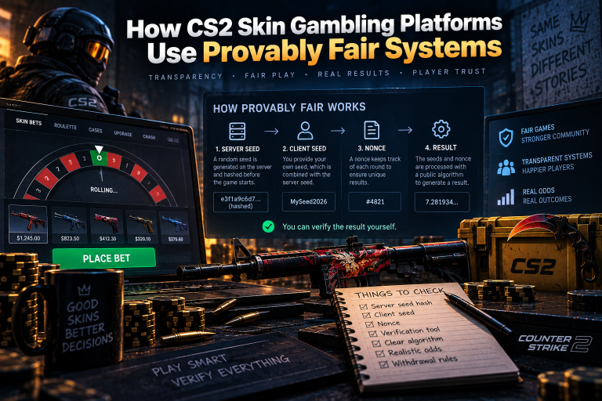
Implementations differ between platforms, but they commonly use a server seed, a client seed, a nonce, and a cryptographic hash. These values are combined according to the site’s published algorithm to generate a result.
For csgo skin gambling, that result might determine a winning ticket, roulette position, or item outcome. The important part is that users can independently repeat the calculation if the platform provides the required information and explains its algorithm clearly.
Server Seeds and Hashes
The server seed is a secret value generated by the platform. Revealing it before a game would allow users to calculate future outcomes, so the site normally publishes a cryptographic hash of the seed first.
A hash acts as a commitment to that value. After the relevant round or seed cycle ends, the original server seed can be revealed. The player can hash it again and compare the result with the commitment published earlier.
If they match, the platform has evidence that it did not replace that server seed after seeing the player’s actions. This commitment process is one of the core parts of a meaningful provably fair implementation.
Why Client Seeds and Nonces Are Used
A client seed adds input associated with the user. Depending on the system, players may be able to change this value themselves. Combining client and server inputs means the final result does not rely solely on a hidden value controlled by the operator.
A nonce usually works as a counter. It changes as rounds or bets are made under the same seed pair, allowing the system to produce different results without requiring an entirely new seed for every action.
Together, these components create a reproducible sequence. A verifier can use the same server seed, client seed, nonce, and algorithm to check whether the displayed outcome matches the calculated one.
How Verification Works in CS2 Roulette
Consider a cs2 roulette game. Before betting, the platform provides the hash of its hidden server seed. The player has a client seed, and the round uses a specific nonce or round identifier.
After the server seed is revealed, the player can enter these values into a verifier. The published algorithm processes them and produces a number that maps to an outcome in the roulette game.
If the calculated position matches the result originally displayed, the round passes that particular verification. A mismatch indicates that something is wrong with the supplied data, algorithm, or reported result.
The exact calculation varies by platform, so there is no universal formula that applies to every site.
Provably Fair Does Not Mean Good Odds
This is the most important limitation. A mathematically verifiable result can still come from a game with poor expected value for the player.
Provably fair technology answers a narrow question: was the outcome generated according to the disclosed inputs and algorithm? It does not tell users whether payout rates are reasonable, whether item valuations are accurate, or how large the platform’s house edge may be.
The same applies when players search for the best cs2 cases to open on third-party platforms. Verifiable randomness does not make a case profitable. Players still need to understand the listed probabilities, possible rewards, and cost of each opening.
What Provably Fair Cannot Verify
Players sometimes treat a provably fair label as a general trust certificate. It is not one.
Even the best csgo gambling sites according to reviews or community discussions need to be evaluated separately for account security, deposits, withdrawals, skin valuation, customer support, terms of service, and compliance with applicable laws. A valid hash cannot prove that a withdrawal will be processed correctly.
Provably fair verification also depends on transparency. If a platform does not explain how seeds are transformed into outcomes, users may have information they cannot meaningfully check.
How to Check a Provably Fair System
Before relying on a site’s fairness claim, find its technical explanation rather than accepting a badge or short marketing statement. Check whether the platform provides the pre-game server seed hash, client seed, nonce, revealed server seed, algorithm, and a way to reproduce the calculation.
A built-in verifier is convenient, but independent verification is stronger because it avoids relying entirely on the same platform that produced the result.
Players should also check whether seeds can be rotated and whether previous seeds become available after rotation. Without the original server seed, the earlier commitment cannot be fully checked.
What Players Should Take From Provably Fair Claims
Provably fair systems give players a practical way to audit randomized outcomes when they are implemented transparently. Hash commitments, server seeds, client seeds, and nonces can show whether a result matches the process disclosed before the game.
That makes the technology useful, but limited. Before using any CS2 gambling platform, verify both the randomness system and the parts it cannot prove, including odds, withdrawals, account security, item pricing, and legal availability. A result being cryptographically verifiable is one check, not a reason to trust the entire service.