



















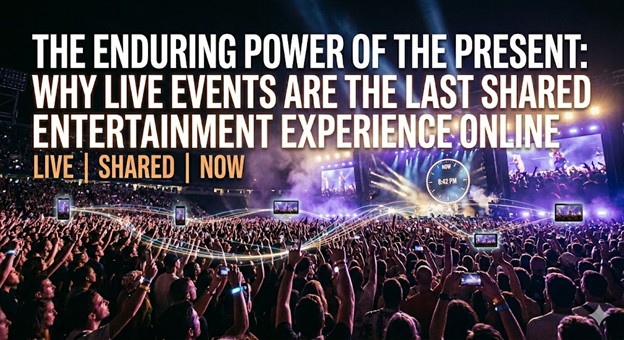
Image Credit - Gemini
The Enduring Power of the Present: Why Live Events Are the Last Shared Entertainment Experience Online
In our digital society, we are currently experiencing a digital paradox. We have created the most sophisticated and ubiquitous communication network ever. We can reach and interact with anyone, anywhere, at any time. But, paradoxically, the users of this network are more socially fragmented and psychologically alienated than ever before.
We are transitioning to an algorithmically mediated future. To understand it, we must consider the events of the end of our collective cultural ephemera and the collective panic to live in real time. In our world, live events (whether real or virtual) are the only places where we can share emotional stimuli simultaneously.
The Collapse of the Cultural Monoculture
Throughout the 20th century, mass media were a potent cultural force for unification. A shared repertoire of cultural references constituted a shared social vocabulary that transcended geographic, economic, and demographic boundaries. The great historical example of such “monoculture” is the 1983 series finale of the television series M*A*S*H. This one episode drew 83 million viewers, or roughly 90% of the American households with TVs tuned in at that moment. It was not the passive consumption of media, it was a simultaneous ritual.
Enter the digital media ecosystem of today, and the media’s structure has been turned on its head. The monoculture has fractured into myriad algorithmically personalized channels. Streams are continuously segmented to meet highly targeted interests. Although the video streaming industry has soared to valuations beyond $811 billion, this shift in viewer behavior to asynchronous and on-demand viewing has its drawbacks.
A streaming success may reach tens of millions of viewers, but will often not enter into the broader cultural lexicon because of asynchronous viewing practices. The “watercooler moment” is a thing of the past, replaced with acute “abundance fatigue” and fragmentation.
The Psychological Architecture of Digital Isolation
The shift from real-time collective experiences to asynchronous, individualised digital consumption has led to significant sociological consequences. The World Health Organization (WHO) recently disclosed that one in six people globally experiences deep loneliness, which is associated with approximately 100 deaths an hour. The US Surgeon General has also declared social isolation to be an epidemic, with its physiological effects equivalent to smoking a pack and a half of cigarettes per day.
In an era of unlimited connectivity, the mechanics of contemporary digital networks can even propagate isolation. The phenomenon of Fear of Missing Out (FOMO) has transformed from a localised and occasional emotion to a global ambient state. Social consumers are constantly fed carefully curated “best of” content, which creates a chronic social deficit.
The results of numerous longitudinal studies, including a nine-year Baylor University study, paint a bleak behavioral picture: the more time people spend interacting with asynchronous social media platforms, the more likely they are to feel lonely. Asynchronous text-based communication lacks the high-bandwidth, multimodal cues (eye contact, micro-expressions, synchrony) that allow us to experience “social presence”. When digital engagement displaces in-person engagement, it comprehensively fails to meet our deep-seated evolutionary need for social connection.
The Digital “Third Place” and the Return to Synchronicity
Our global technology and media industries are in transition to counter the severe psychological harms of the solo viewer. Software engineers are working to make online environments simulate the sociality, spontaneity, and time-sensitivity of real life.
In the past, humans gathered in physical “third places” like cafes, bars, and playgrounds to rendezvous and socialise. In 2019, with the loneliness epidemic revealing the emotional deficiencies of text-based online communication, the online third place has unsurprisingly evolved into highly sophisticated real-time environments. Digital third places are online gaming communities and streaming platforms (Twitch, YouTube Live). With built-in chat, real-time polls, and audience interactions with the host, a unidirectional broadcast is transformed into a bidirectional conversation.
The need for social interaction is present across the internet. Even industries that have historically focused on processes that were more automated and individual are changing. For instance, the huge popularity of live casino games shows that, given the choice, players do not want to play against a soulless machine but to chat with other online players and be dealt with by a real human dealer. With the use of high-definition video and live chat, these sites recreate the materiality and sociality of a “real” world, and address the issue of trust created by computer randomness.
The Convergence of Commerce, Community, and Live Interaction
The business need for digital synchronization is increasingly reshaping the world of commerce and retail. “Live commerce”, a dynamic amalgam of live video streaming, live entertainment, and instant purchases, is one of the most powerful manifestations of the digitized.
Live commerce leverages urgency, authenticity, and community. Demonstrations of products are unfiltered, and the live broadcast permits consumers to post questions and get real-time answers. The economic figures are astounding: conversion rates for asynchronous e-commerce platforms – those in which buyers and sellers are not interacting live – are between 2% and 3%, whereas those for interactive live shopping range from 9% to an astonishing 30%. It’s not just product purchases; it’s an engaging, fun cultural event.
This shift is also taking place in health, well-being, and education platforms. New fitness platforms now heavily rely on sophisticated AI and biometric devices not for isolated step counting, but to support interactive streamed classes and live leaderboards. Through the inclusion of human interaction and real-time feedback, these platforms turn individual workouts into collaborative experiences.
Amplifying Human Ingenuity in an Automated Future
As Artificial Intelligence is embedded into the global economy, with estimates from Goldman Sachs suggesting that AI may automate up to 70% of jobs, an interesting economic dynamic is happening. The core value of genuine, organic, unpredictable human interaction is exploding.
Artificial Intelligence can process information and create media content in the blink of an eye, but it cannot reproduce the unscripted, unpredictable nature of a live concert in a stadium, the unfiltered response of a live shopping host, or the communal experience of a virtual event. The spontaneous, unscripted element of human interaction has become the pinnacle, premium market differentiator.
In the end, live events – both in the sense of big physical gatherings and their highly coordinated, interactive digital equivalents – are the last and only remaining shared entertainment experiences online. They require the one resource that cannot be artificially created or monopolized by algorithms: our real-time human attention. In an age of ephemeral digital chatter and artificial media, the simple act of sharing an experience in real-time with other human beings is our most potent, essential, and sustainable connection.