















Where Roulette Came From And Why The Wheel Has A Zero
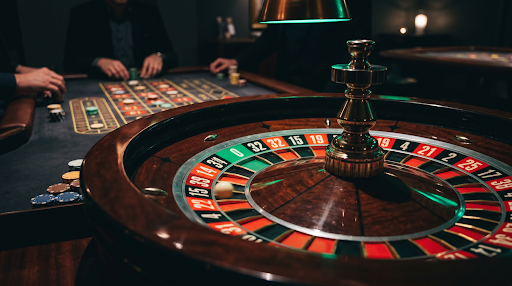
Why would a wheel numbered 1 to 36 need a green pocket that hardly anyone bets on? The answer explains almost everything about roulette, from the way it pays to the reason a small principality on the Mediterranean built a fortune around it.
The zero has been part of the game since it took shape in late 18th-century Paris, and the number of zeros on a wheel has been a commercial decision ever since.
From Paris Salons to Monte Carlo
Roulette’s origins are hazier than its legend suggests. A popular account credits the 17th-century mathematician Blaise Pascal with a primitive version built while he chased a perpetual motion machine, and the mechanism is often traced to a gaming wheel invented around 1720 combined with the Italian game Biribi.
The name was already in use by 1758, when regulations in New France, now Québec, banned dice, hoca, faro and roulette. By 1796 the game had taken its modern form in Paris, and Jaques Lablée’s novel La Roulette, ou le Jour, published in 1801, describes a Palais Royal wheel with two house pockets, a zero and a double zero.
Those early Paris wheels coloured the single zero red and the double zero black, a confusing scheme replaced by green during the 1800s. In 1843, twin brothers François and Louis Blanc introduced a single-zero wheel at Bad Homburg to win players from rival casinos, and when Germany moved against gambling, the family took the idea to Monte Carlo.
Local legend says François Blanc bargained with the devil for roulette’s secrets. The story owes its staying power to a neat coincidence, since the numbers 0 to 36 add up to 666.
What the Zero Actually Does
Every roulette payout is calculated as if the zero did not exist, and that single design choice is the whole business model. The zero adds a pocket that wins for the house on almost every bet without changing what winning bets pay. The three steps below show how one green slot turns a fair game into a profitable one.
The same arithmetic carries over to screens. At an online casino such as elite spin casino no deposit bonus, two details shape what the zero costs before any chip is placed: whether la partage or en prison applies to even-money bets, and whether a multiplier version of the game trims the standard straight-up payout.
Evolution’s Lightning Roulette is the best-known example of the second point, paying 29 to 1 on a straight-up win unless the number has been struck by a multiplier of 50x to 500x.
Fair Odds Versus Paid Odds
A straight-up bet on a single number pays 35 to 1. On a wheel with only the numbers 1 to 36, that payout would match the true odds exactly, so the casino would earn nothing over time.
Adding a zero creates a 37th pocket while the payout stays the same. The gap between the true odds of 36 to 1 and the paid odds of 35 to 1 is where the house makes its money.
Why One Pocket Is Worth 2.7%
Imagine betting A$1 on each of the 37 pockets in a single spin. One bet wins and returns A$36, the winnings plus the stake, from A$37 laid out, so the missing dollar represents 1/37 of the total, or about 2.70%.
The same edge applies to almost every bet on a single-zero wheel. Even-money bets such as red or black lose to the zero as well, winning 18 times in 37 instead of 18 in 36.
How Each Extra Zero Adds More
A double-zero wheel has 38 pockets with the same payouts, so the house keeps 2/38, about 5.26%. A triple-zero wheel takes 3/39, about 7.69%, nearly three times the European figure, and the American five-number bet on 0, 00, 1, 2 and 3 is worse still at about 7.89%.
Rules That Soften the Zero
Not every table treats the zero the same way, and a few traditional rules give back part of its bite on the simplest bets. The main ones are worth recognising on any table rules page:
- La partage: when the ball lands on zero, even-money bets lose only half their stake instead of all of it.
- En prison: the even-money bet is held for the next spin and returned if that spin wins for it.
- Single-zero French tables: with either rule in place, the edge on even-money bets falls to about 1.35%.
- Half-back on double zero: some double-zero tables apply a similar rule, cutting the even-money edge to about 2.63%.
These rules protect only outside bets such as red, black, odd and even. Straight-up, split and corner bets keep the full house edge of the wheel they are played on. Online, tables that use these rules are often labelled as French roulette, and the help screen confirms which rule applies.
Why America Kept Two Zeros
The double-zero wheel never faced the price war that shaped Europe. Early American wheels went even further, with the numbers 1 to 28, a single zero, a double zero and an American Eagle slot, all of which worked as house pockets. Hoyle’s rules described those slots as sweeping every bet on the table except wagers placed on them.
The Eagle eventually disappeared, but the double zero survived as the game spread up the Mississippi from New Orleans. Cheating problems also pushed operators to move the wheel onto the table top, which helped give American roulette its distinctive layout.
Europe settled on one zero largely because the Blancs used it as a competitive weapon, while American operators faced less pressure to give up the extra pocket. The result is a game that looks almost identical on both continents but costs players nearly twice as much on an American wheel.
Triple Zero and the Cost of Not Noticing
A third zero arrived at the Venetian in Las Vegas in the autumn of 2016. Casinos often mark the extra pocket with a logo instead of a number, so casual players may not realise the wheel carries 39 pockets.
Mathematician Christopher Ingrassia simulated the difference for a gambling conference, comparing US$10 spins on triple zero with US$100 spins on single zero, a split that reflects typical table minimums. Starting with US$500 and aiming to win US$100, his single-zero players hit the target more than 80% of the time, against around 20% on triple zero. Doubling that US$500 happened in just 3 of 10,000 triple-zero trials, compared with about 40% at the single-zero wheel.
The Zero in Numbers
The cost of the zero depends on how many there are and which house rules apply. The table below sets the main wheels and rule sets side by side:
| Wheel | Pockets | House edge | Notes |
|---|---|---|---|
| European (single zero) | 37 | 2.70% | The standard in Europe since the Blancs’ era |
| Single zero with la partage or en prison | 37 | About 1.35% on even-money bets | Other bets stay at 2.70% |
| American (double zero) | 38 | 5.26% | The five-number bet rises to about 7.89% |
| Double zero with a half-back rule | 38 | About 2.63% on even-money bets | Offered on some double-zero tables |
| Triple zero | 39 | 7.69% | Introduced at the Venetian in Las Vegas in 2016 |
Reading the wheel before the first bet is the simplest protection a player has. Counting the pockets and checking the rules for even-money bets takes seconds and can halve the house edge on some wagers.
Conclusion
Roulette grew out of 18th-century France with two house pockets, and the zero has remained its built-in commission ever since. The Blancs’ single-zero wheel made Monte Carlo famous, while America kept the double zero and Las Vegas later added a third.
For players, the number of zeros and the rules on even-money bets matter far more than any betting system. Anyone who finds the wheel taking more time or money than planned can contact Gambling Help Online for free, confidential support at any hour.
FAQ
Why does a roulette wheel have a zero?
The zero gives the casino its edge. Payouts are set as if there were only 36 numbers, so the extra pocket means the house keeps about 2.7% of every bet over time.
Who invented the single-zero roulette wheel?
Twin brothers François and Louis Blanc introduced the single-zero wheel at Bad Homburg in 1843 to attract players from rival casinos, and later made it the main game in Monte Carlo.
What is the difference between European and American roulette?
European wheels have 37 pockets with one zero, while American wheels have 38 with a zero and a double zero. That extra pocket raises the house edge from about 2.70% to 5.26%.
What is the house edge on triple zero roulette?
About 7.69%, because a triple-zero wheel has 39 pockets but pays the same as a single-zero wheel. That is nearly three times the European edge.