


















Melbet Login Myanmar: Account Access, Password Recovery and Security Tips
There are multiple reasons why a login may fail. A few reasons may be an unstable internet connection or a slow verification message. The user may be using an outdated password. Each issue requires a different solution, and identifying the cause early can help users avoid unnecessary password resets and suspicious links.
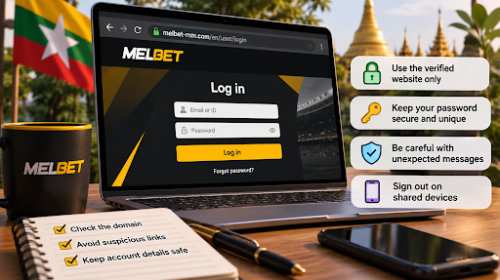
The Melbet login Myanmar page provides an entry point for the operator’s Myanmar-facing platform. Customers access their accounts and profiles using this address. Login details are encrypted during transmission using HTTPS. However, fraudulent websites can still capture login details. To reduce the risk of visiting a fraudulent website, customers should always verify the full domain name. Criminals create fake websites with interfaces and logos resembling legitimate sites and capture customers’ account information.
The failure of a user to login to an account does not necessarily mean account theft has occurred. Configuration settings of web browsers, typing errors, and transient service interruptions can all cause invalid logins to occur. Due to the nature of the security checks implemented on some systems, repeated attempts to login with a password can result in additional security checks being triggered.
Common Reasons for Login Problems
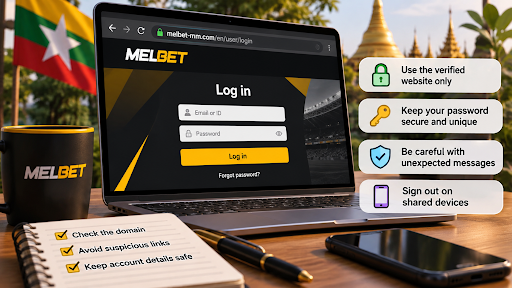
One of the simplest explanations for a rejected login attempt is using incorrect credentials. Saved passwords become outdated after an account change. Typing a password incorrectly happens for a variety of reasons such as typing on a keyboard with an unfamiliar layout, or automatically capitalizing letters. Check for these reasons before contacting support for a password reset.
Issues loading a web page may be caused by using outdated cookies or an expired session. One way to check this is to open the verified URL in a different browser. Deleting stored information should be considered only when the checks above have been attempted.
The wider Melbet platform combines sports, gaming and account-related sections. There are many ways users can access the login area of the site, but links in emails and messages that you do not recognize should be considered suspicious. A copied page may look genuine while sending credentials elsewhere.
Recognising Phishing and Fake Support Messages
Phishing attempts frequently imitate account notifications. Messages can claim that a profile has been suspended or that an unfamiliar payment requires immediate confirmation. Phishing messages may exploit concerns about security incidents or lost account access. However, just because a message urges the recipient to act or to access a link, it doesn’t necessarily mean there is a real security emergency. Users should open the service’s verified website directly instead of following links in security alerts. If a user’s credentials have been stolen, the user should change the password and secure the account through trusted, verified recovery options.
Fraudulent addresses may contain extra words or be misspelled. A padlock in the address bar only means that the connection is secure and encrypted. Additionally, an address can be shortened to conceal its actual location. Passwords and one-time codes should never be given out over unsolicited conversations. Someone claiming to be customer support may be trying to defraud you. Receiving a request to give out payment credentials is a big red flag and shows that the case is likely to be fraudulent.
Password Recovery and Troubleshooting
Forgotten passwords cannot be addressed the same way as page load failures. Temporarily interrupting the network cannot be solved by changing credentials. In the following table, the most common symptoms are separated from the first possible checks.
| Problem | Possible explanation | Recommended response |
| Password rejected | Incorrect or outdated credentials | Check saved details and keyboard settings |
| Login page unavailable | Connection or service interruption | Test the connection and retry later |
| Verification message missing | Delivery delay or outdated contact information | Check the registered contact channel |
| Unexpected reset request | Possible unauthorised recovery attempt | Avoid the link and review account security |
| Unrecognised account activity | Potential credential exposure | Secure the account and contact verified support |
Password recovery processes should begin from the verified login page. Users should follow the on-screen instructions from that page instead of following the instructions from unknown senders. Unexpected password reset notifications do not always mean that someone unauthorized gained access. However, they may warrant further suspicious activity checks.
Responding to Suspicious Account Activity
An unfamiliar sign-in notification may indicate a compromised password, although it can also result from a new device or an unusual login location. The user should change the password for that service and any identical or similar passwords used on other accounts.
A short response checklist can help organise the next steps:
- Replace exposed credentials: Create a unique password rather than modifying an old one slightly.
- Review connected devices: End unfamiliar sessions if the platform provides that option.
- Check contact information: Look for unexpected changes to recovery details.
- Inspect account records: Identify actions or transactions that the owner does not recognise.
- Report suspicious activity: Use support channels obtained from a verified website.
Support staff may request relevant account details or transaction references when investigating suspicious activity. Passwords and full payment details should not be captured in a screenshot.
Accessing Accounts on Mobile and Shared Devices
Someone closing a browser tab can still be a problem on a shared computer. This is due to the computer possibly saving the login information. It is therefore better to sign out than to close a tab. Private browsing can reduce some local traces on the computer, but this cannot fully protect you when you are using an untrusted computer.
For example, a lost smartphone may put accounts at risk if there is no lock screen, or if the lock screen can be easily guessed. It is recommended to update the operating system of the phone when an update is made available, to enable unique passwords, and to use two-step verification if available.
Online Gambling Restrictions in Myanmar
Myanmar’s Cybersecurity Law was enacted on 1 January 2025, with effect from 30 July 2025. It introduces a framework on online gambling systems operated without a license. A functioning login page does not, by itself, constitute a legitimate online gambling system. Foreign licenses do not relieve local requirements.
People who are interested in sports can use various applications to find fixtures, results, and other statistics without having to engage in financial betting.
Maintaining Reliable Account Access
Keeping your contact information accurate and up to date can help resolve account access issues. Reporting fraudulent messages through verified support channels may help prevent further phishing attempts.
Users should be aware which security controls their selected platform actually supports. A secure password is one of the numerous control provisions that helps manage access to a protected system and cannot determine if a service is trustworthy or legally authorised. Responsible account management begins with verified information and appropriate security settings.