

















Which U.S. States Produce the Most UFC Fighters? And Which Produce the Most Dangerous Ones?
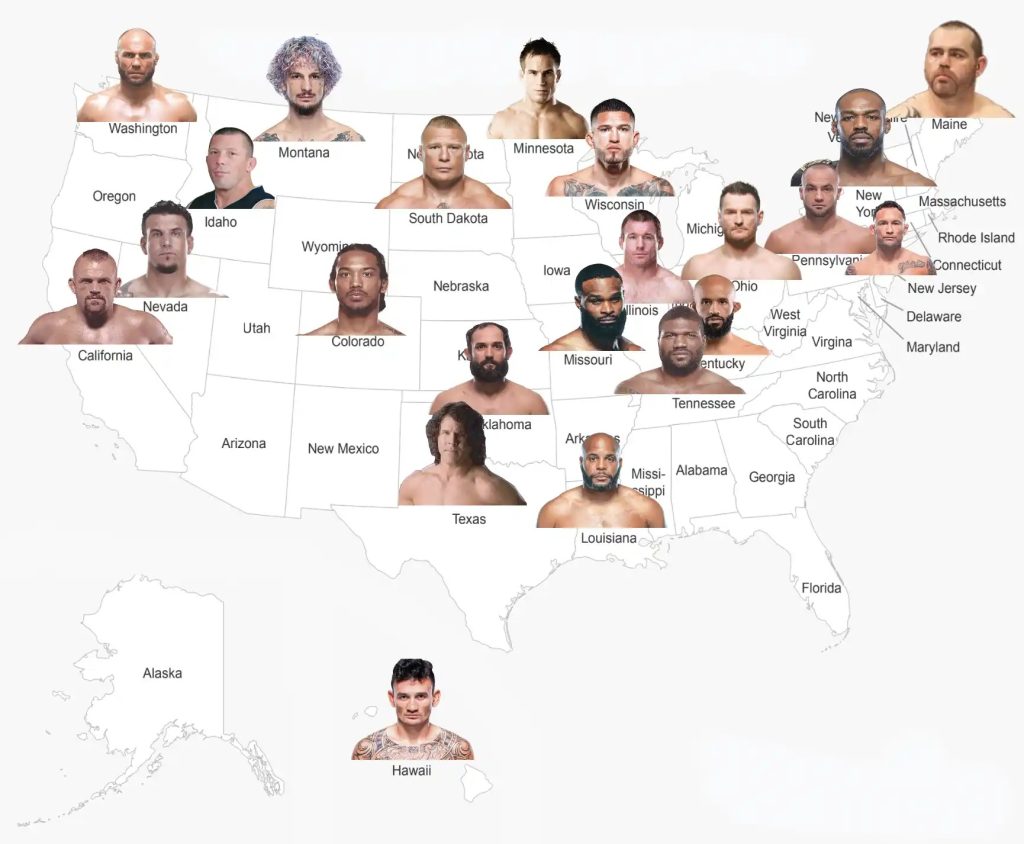
Every UFC fighter comes from somewhere. Some grow up around world-class gyms and deep coaching networks. Others come from places with barely any MMA scene at all. So where do the Octagon’s fighters actually come from, and does where you’re from shape how you fight?
To find out, Lucky Rebel dug into every UFC fight from 1993 to 2026. We looked at which states send the most fighters to the Octagon, which ones produce the highest knockout rates, and how the U.S. stacks up against the rest of the world.
It turns out those are two very different questions. The states that produce the most fighters are not the ones producing the most dangerous ones, and the gap between the two reveals a lot about how fighting styles vary from place to place.
Here’s what the numbers show.
Key Findings
- California produces 256 UFC fighters, more than any other state and nearly triple second-placed Texas.
- Louisiana leads the U.S. in KO win rate at 22.4%, just ahead of Nebraska (22.3%) and Alaska (21.4%).
- Ohio hits a 20.77% KO win rate, the highest of any high-volume state, with just 43 fighters on the roster.
- New Jersey has the lowest KO win rate of any measured state at 7.41%. Its fighters are actually more likely to get knocked out (14.81%) than to knock someone out.
- Derrick Lewis (Texas) leads all fighters with 16 KO wins. Francis Ngannou leads on KO win percentage at 71.43%.
- Russia has the highest win rate of any major nation at 64.20%, and its fighters average longer bouts (688 seconds) than any other top-10 country.
- New Zealand has the highest KO rate on the planet at 28.47%, nearly double the U.S. rate of 16.21%.
The States Producing the Most UFC Fighters
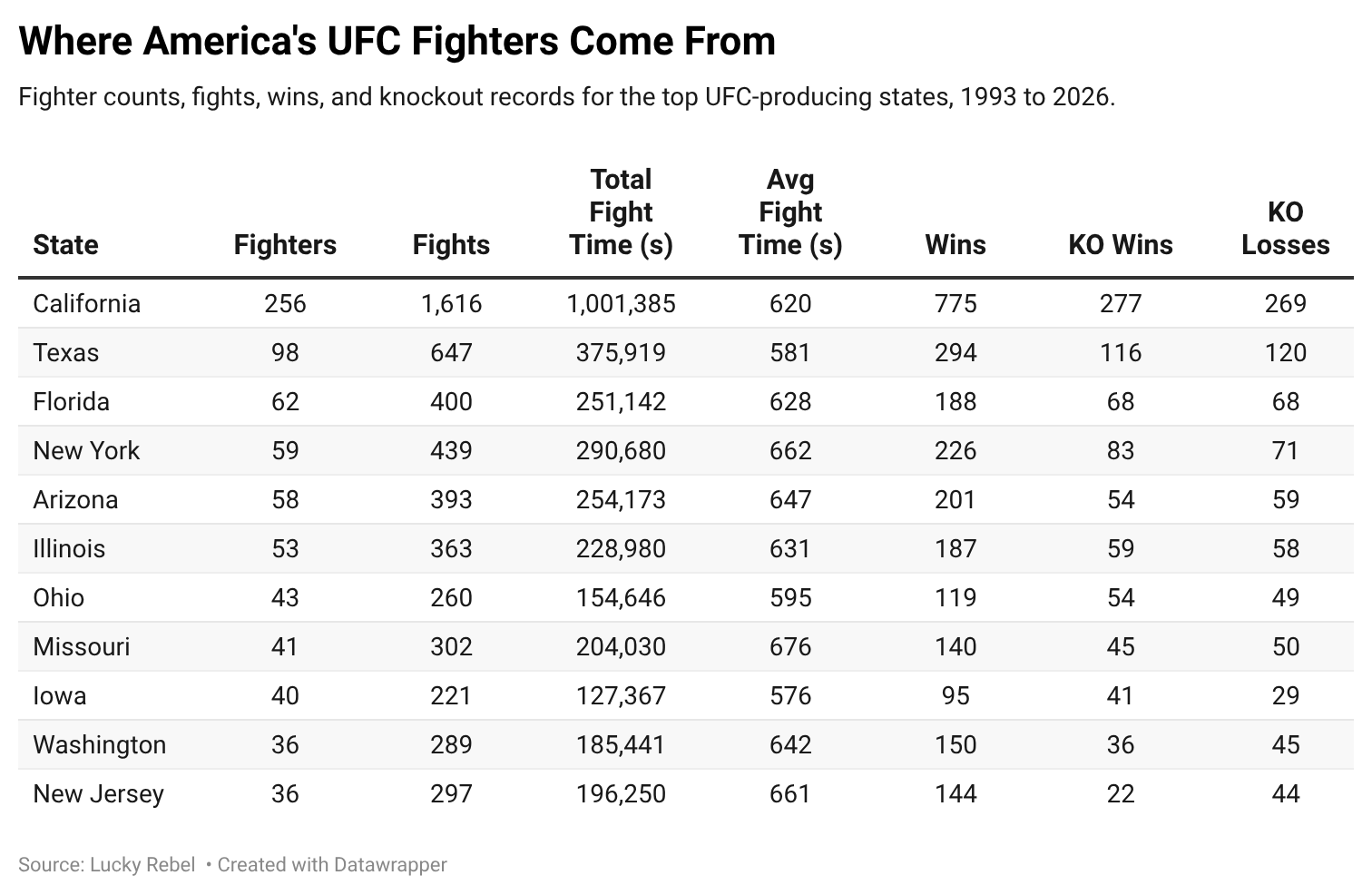
Thirty states have produced 10 or more UFC fighters. California leads by a mile: 256 fighters across 1,616 fights, nearly three times as many as Texas in second place.
Florida (62), New York (59), and Arizona (58) form the next tier. These are established hubs with strong gyms and deep coaching networks.
But here’s the catch: volume tells you almost nothing about danger. California’s KO win rate of 17.14% is firmly mid-table. Its fighters have been knocked out almost as often as they’ve knocked opponents out: 269 KO losses against 277 KO wins.
New York might be the most well-rounded of the top five, pairing a 51.48% win rate with an 18.91% KO win rate. Arizona is more technical. It wins at a similar clip but finishes at just 13.74%.
Some of the best stories hide at the bottom of the table. Tennessee (13 fighters) and Alaska (13) both post KO win rates above 21%. Small rosters, heavy hands.
Utah sits at the opposite extreme. Its 17 fighters manage a 9.18% KO win rate and a 36.73% overall win rate, the lowest in the study on both counts.
Minnesota (9.02%) and New Jersey (7.41%) round out the low end of finishing power. All three states fit a pattern you’d expect from grappling-first training cultures, where fights get decided on the mat or on the scorecards instead of by stoppage.
The States With the Highest Knockout Rates
Forget fighter volume for a moment, and a whole new group of states rises to the top. None of them are traditional MMA hubs. All of them finish fights at rates California, Texas, and Florida can’t touch.
1. Louisiana: 22.4% KO win rate
Louisiana is the knockout capital of America. Dustin Poirier, with 11 career KO wins from 32 fights, is the state’s most famous export. Fighters from Louisiana are roughly 30% more likely to win by knockout than fighters from California. That gap is a real stylistic difference, not statistical noise.
2. Nebraska: 22.3% KO win rate
Nebraska sits a fraction behind Louisiana and well above the national average. The state produces far fewer UFC fighters than the big hubs, but the ones it does produce finish at an elite rate. Drew Dober, with 11 KO wins from 27 fights, is the clearest example.
3. Alaska: 21.4% KO win rate
Alaska near the top of this list is striking. From a small pool of UFC fighters, the state posts a finishing rate that beats most high-volume states. It fits a tough-minded, get-it-done fighting culture.
4. Tennessee: 21.2% KO win rate
Tennessee lands firmly among the country’s most dangerous finishing states. It has produced a steady stream of aggressive, pressure-based fighters who look to end fights early rather than trust the judges.
5. Nevada: 20.9% KO win rate
Nevada rounds out the top five. Since Las Vegas is the UFC’s home base, some of this may come from fighters who relocated to train at Nevada’s elite gyms. Either way, the finishing rate sits well above California or Florida.
The Global Picture: How the U.S. Compares
The United States dominates the UFC roster by sheer numbers, with 1,389 fighters accounting for the majority of all bouts in the dataset. But on the metrics that matter most, win rate and finishing power, several smaller nations punch well above their weight.
Russia is in a league of its own on win rate. Its 80 fighters win 64.20% of their bouts, by far the highest of any major nation and more than 16 percentage points above the U.S. Russian fighters also average the longest bouts in the top 10 at 688 seconds. That points to a patient, control-based style that wins on the scorecards rather than chasing early finishes.
France and New Zealand show two very different roads to the same destination: the finish. France’s 28 fighters knock out opponents at 21.69%, one of the highest rates in the world and comfortably above the U.S. average. New Zealand goes even further. Its 13 UFC fighters post a KO win rate of 28.47%, the highest of any nation in the dataset and nearly double the U.S. rate of 16.21%.
Brazil, the second-largest producer of UFC fighters, pairs a 52.02% win rate with a 16.09% KO rate. That’s almost identical to the U.S. on finishing, but better overall.
Canada sits at the other end with a 13.47% KO win rate, the lowest of any top-10 nation. It reflects a grappling-heavy tradition that echoes technical U.S. states like New Jersey and Washington.
The Fighters Behind the Numbers
The table below ranks fighters by total KO wins across their UFC careers. It measures volume, not rate. Fighters with longer careers naturally rack up more stoppages. But these are the individuals who have most shaped the knockout culture of their home states and countries.
Derrick Lewis (Texas) leads everyone with 16 KO wins from 31 fights. His 51.61% KO win rate is the highest among the volume leaders, though he has also been knocked out 8 times. That’s the trade-off for a fighter who is always hunting the finish.
Francis Ngannou (Cameroon) is the standout on pure percentage: 10 knockouts from just 14 fights at 71.43%, with zero KO losses. That record captures both his extraordinary power and the shortness of his UFC run.
Cain Velasquez (California) is the biggest surprise. He’s known primarily as a wrestler, yet 66.67% of his wins came by knockout.
Donald Cerrone (Colorado) shows what longevity looks like in this dataset: 38 fights, 10 KO wins, but 8 KO losses. That’s the profile of a durable fighter who’s been in the wars, not a pure finisher.
What This Tells Us About MMA
Three decades of UFC data point to one big conclusion: the sport is far more geographically diverse, and more stylistically varied, than its surface image suggests.
The United States dominates by volume. But the most dangerous finishers are not clustered in California or Florida. They come from Louisiana, Ohio, and Nebraska, and from countries like New Zealand and France that the sport rarely associates with knockout power.
California will keep sending more fighters to the Octagon than anywhere else. But the athletes who can end a career with a single punch are coming from places that don’t appear on the conventional map of MMA. The sport has spread. So has the danger.
Methodology
We built a database of every UFC fight in history using Kaggle datasets, supplemented with independent research to fill any gaps through to April 2026.
Fighter birthplaces were sourced from additional datasets and verified using Wikipedia and Tapology where needed. To ensure consistency, all fighters were assigned to a country based on their place of birth, rather than nationality or fight location.
We then analyzed fight outcomes by country, including win rate, knockout and submission rates, and overall finishing percentage. Striking and grappling data were sourced from UFCStats.com.
Only countries with at least 10 UFC fighters were included to ensure reliable comparisons.