









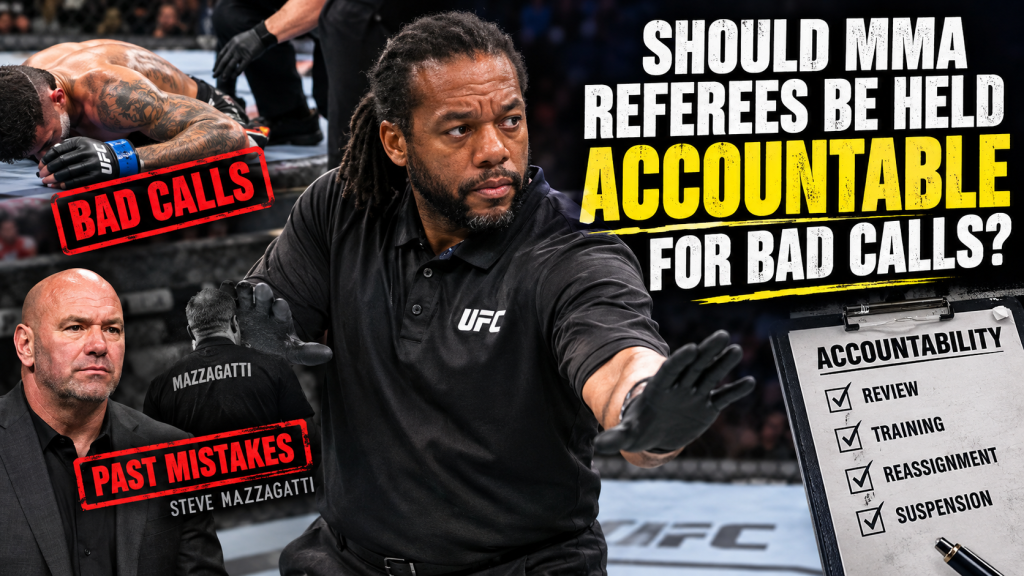
Should MMA Referees Be Held Accountable for Bad Calls?
MMA fighters live with consequences.
Lose a fight because you were outperformed, and you take it on the chin. Lose because you made a tactical mistake, and you learn from it. Get knocked out, and you deal with the physical and professional aftermath.
But what happens when the outcome of a fight is significantly affected by the person standing inside the cage with you?
That is where the debate over referee accountability becomes unavoidable.
Referees are human. They are going to make mistakes. The speed, violence and unpredictability of a professional MMA fight make perfect officiating virtually impossible.
But there is a difference between making an understandable mistake and developing a pattern of questionable officiating without meaningful consequences.
And that is why MMA referees should be held accountable for bad calls.
The question is what that accountability should look like.

Herb Dean’s Recent Controversies Put the Issue Back in the Spotlight
Few referees have been more respected in MMA than Herb Dean. For years, he has been regarded as one of the sport’s most experienced and recognizable officials.
But 2026 has been a difficult year for Dean.
At UFC 332 on Oct. 3, Dean stopped the King Green-Esteban Ribovics fight after Green was dropped three times in the opening round. Green was visibly hurt, but he was not unconscious and immediately expressed his belief that he should have been allowed to continue.
UFC CEO Dana White subsequently acknowledged the controversy, saying Dean was having a “rough f—ing year,” although White also noted that he had seen worse stoppages.
That incident came after several other controversial situations involving Dean.
At the UFC White House event in June, Dean was criticized after Ciryl Gane landed illegal blows to the back of Alex Pereira’s head while attempting to finish the fight. Pereira subsequently placed much of the blame on Dean, arguing that it was the referee’s responsibility to distinguish legal from illegal strikes.
Dean also became the subject of controversy during a September episode of Dana White’s Contender Series when Ian Escuza finished Luca Borando with a series of ground strikes that included an illegal knee to a downed opponent. Dean and Nevada State Athletic Commission officials reviewed the sequence and allowed the TKO result to stand.
And those incidents have now prompted fighters such as Henry Cejudo to openly question whether Dean should continue officiating at the highest level. Cejudo has specifically called for Dean to be removed from refereeing, arguing that there has been a lack of accountability.
That doesn’t necessarily mean Dean is a bad referee.
It does mean the sport has reached the point where his recent performances deserve serious evaluation.
Mistakes Are Going to Happen
There is an important distinction that often gets lost when fans become angry.
A referee has an incredibly difficult job.
He or she has to watch two elite athletes moving at extraordinary speed while simultaneously evaluating damage, intelligently defending positions, illegal strikes, submissions, fighter safety and whether a competitor can intelligently defend himself.
There is no replay available in the referee’s head.
Sometimes the official simply gets it wrong.
That should not automatically result in punishment.
In fact, Dana White himself once made an important point while criticizing another referee. After a controversial stoppage involving Herb Dean in 2021, White acknowledged that Dean was human but argued that he needed to correct his approach.
That’s the reasonable standard.
You don’t punish someone simply because they made one mistake. You evaluate whether they are learning from their mistakes and whether their overall performance remains acceptable.
Then There Is the Steve Mazzagatti Era
If there is a historical example of the opposite approach, look no further than Steve Mazzagatti.
Mazzagatti became one of the most criticized referees in UFC history, and UFC leadership was not shy about expressing its frustration.
In 2009, Dana White went so far as to call Mazzagatti the “worst ref in history” while discussing his officiating in the first Brock Lesnar-Frank Mir fight. White specifically criticized Mazzagatti’s handling of the fight, including his decision to stand the fighters up after an illegal strike and his response when Lesnar tapped.
Years later, White was still publicly criticizing Mazzagatti.
During The Ultimate Fighter in 2014, Mazzagatti’s handling of a bout involving Ian Stephens and Roger Zapata became another major controversy. White again questioned his officiating, saying a referee should be in control of the fight and that fighters, judges and fans should understand what is happening.
And Mazzagatti’s reputation became so synonymous with questionable officiating that White later used his name as a benchmark for bad refereeing. In 2020, after Chris Tognoni made a controversial call in the Ed Herman-Mike Rodriguez fight, White described it as “Mazzagatti level” officiating.
That’s quite a legacy.
But here’s the important part:
Why did it take so long for the system to address the problem?
Fighters Don’t Get Unlimited Second Chances
This is where the argument for referee accountability becomes strongest.
Imagine a fighter repeatedly making serious mistakes.
They consistently fail to defend takedowns. They repeatedly miss weight. They continually commit fouls. They make tactical errors that cost them fights.
Eventually, the promotion may stop booking them.
That’s professional accountability.
Yet referees can make mistakes that potentially change a fighter’s career, and there is often very little transparency about what happens afterward.
A premature stoppage can cost a fighter a victory.
A failure to stop a fight can potentially cause serious injury.
A missed foul can affect a championship fight.
A mistaken timeout can alter momentum.
And a bad call can change a fighter’s record forever.
The fighter carries that result on their résumé.
The referee usually goes home.
That imbalance deserves examination.
Accountability Doesn’t Mean Public Humiliation
There is also a danger on the other side.
Referees shouldn’t become convenient punching bags whenever fans disagree with a decision.
Judges and referees routinely receive death threats and vicious abuse on social media. That isn’t accountability. It’s harassment.
Nor should promoters publicly pressure officials into making decisions that favor particular fighters.
The athletic commissions—not promoters, fighters or fans—should ultimately oversee referee performance.
But commissions should have a formal process for doing it.
What Should Accountability Look Like?
MMA could adopt a much more transparent system for evaluating officials.
After controversial fights, commissions could conduct a formal review and determine whether the referee:
Made a correct call.
Made a reasonable mistake.
Made a significant officiating error.
Demonstrated a recurring problem.
Requires additional training.
Should temporarily be removed from high-profile assignments.
There could also be a system of progressive discipline.
First serious mistake: review and education.
Repeated mistakes: additional training and temporary reassignment.
Pattern of major errors: suspension or removal from certain levels of competition.
Persistent inability to meet the standard: no longer officiate at that level.
That’s not radical.
It’s how professional sports maintain standards.
MMA Needs to Stop Pretending Officials Are Above Accountability
The irony is that MMA already has mechanisms for reviewing fights.
Officials can consult replay in certain circumstances. Commissions can review incidents. Fighters can appeal certain decisions. Rules can be clarified.
But the public rarely gets a clear picture of what happens to a referee after a major mistake.
That creates the perception that referees are essentially untouchable.
And perception matters.
If a fighter loses because a referee made a mistake, fans deserve to know that the mistake was examined.
The fighter deserves to know.
And, perhaps most importantly, the referee deserves the opportunity to learn from it.
Herb Dean Shouldn’t Be Fired Because of One Controversial Fight
This isn’t an argument that Herb Dean should automatically be removed.
Quite the opposite.
Dean’s decades of experience and long record of successful officiating should matter.
But his reputation should not provide immunity from scrutiny either.
If a referee with decades of experience suddenly becomes involved in a string of controversial calls, the appropriate response isn’t to ignore it because of his résumé.
It’s to review the calls.
Was each decision defensible?
Were there common mistakes?
Was the official positioned correctly?
Did he follow the rules?
Did he respond appropriately after the incident?
Is additional training necessary?
Those are questions the commission should be able to answer.
The Bottom Line
MMA is a sport where tiny moments can change everything.
A missed punch doesn’t necessarily change a fight.
A missed foul can.
A late stoppage can cause unnecessary damage.
An early stoppage can take away a fighter’s opportunity to win.
And a referee’s mistake can become a permanent line on somebody else’s professional record.
That’s why referees should be accountable.
Not because they are expected to be perfect.
Because nobody in a professional MMA contest should be exempt from professional standards.
Steve Mazzagatti’s career became a cautionary tale about what happens when repeated officiating controversies become part of an official’s identity. Herb Dean’s recent controversies demonstrate that even one of MMA’s most respected referees isn’t immune from scrutiny.
The answer isn’t to throw referees under the bus.
It’s to build a system that identifies mistakes, corrects them, trains officials, protects fighters and, when necessary, removes officials who can no longer meet the standard.
Fighters are held accountable for what happens inside the Octagon.
Maybe it’s time we demanded the same level of accountability from the people responsible for making sure the contest is conducted correctly.